
Watch above or read below.
Matthew Burns:
I’m going to rush into this one because this is a big topic. It’s a big topic. And Gary and I both feel very passionately about this. So I want to ask this question to everybody. We just had this experience with a client, and we’ve had multiple experiences over time, but this is the most recent one, and this is why it’s so topical for us.
As a business owner, should I remove my one-star reviews? But you get a nasty review, you get a complaint, you get somebody who doesn’t like your marketing, and somebody saw one of your trucks, and it was dirty. And you just-
Gary Bernier:
One of your techs didn’t do the job properly and you’ve gotta go back, whatever the situation is. Doesn’t matter.
Matthew Burns:
Whatever the situation is. Should you remove it? Should you go through the process of trying to get that thing taken off of Google so that you can get your star rating to be…
Gary Bernier:
Higher, higher, higher! I want to be five stars, man. I want to be five stars. Come on, Matt!
Matthew Burns:
What was the number, though? There’s an industry thing happening up there that it should be 4.8.
Gary Bernier:
It can’t be 4.7. I got to be 4.8 or higher. It’s going to screw up my GMB ranking and blah blah blah.
Matthew Burns:
Okay. So I’m going to say this, Gary, you can tell me if I’m full of crap or not, because again, I’m on the branding side. I’m an ad writer. I’m a strategist. I don’t live in that world, but I’m going to say I’m going to make this call. The belief and trust in Google Reviews is declining anyway, especially five-star reviews.
Gary Bernier:
It is. Okay.
Matthew Burns:
So again, that’s me being totally out there. You can totally put this into perspective.
Gary Bernier:
Okay. So review systems, absolutely. People are becoming a little bit more skeptical of review systems. I’ll say it that way. They’re a little bit more skeptical.
Matthew Burns:
Fair.
Gary Bernier:
Because there’s nothing wrong with the system. It’s the way the business owners are trying to manipulate them that’s causing people to be skeptical.
Matthew Burns:
Right. Okay.
Gary Bernier:
Because it’s like falsifying the data. Look, I’m better than I am.
Matthew Burns:
Right.
Gary Bernier:
And the review system was put in place to kind of give the consumer an accurate rating of the type of business they’re dealing with.
Matthew Burns:
Right.
Gary Bernier:
Right? Yeah. If the restaurant’s a three-star restaurant, it’s a three-star restaurant. If it’s a one-star restaurant, our door is still open. It’s supposed to say, “The food’s not good here.” Or the experience is absolute garbage. It’s supposed to be valid.
Matthew Burns:
Exactly. You got it. Yeah. The waiter coughed and sneezed all over my food. They need to be able to say, “Hey, just be careful.”
Gary Bernier:
Right. But that’s a singular experience. I’m saying the overall general rating is supposed to be a valid indicator of how generally good that business is at doing the thing they do.
Matthew Burns:
Yes.
Gary Bernier:
So the advice that you got to be 4.7, 4.8, 4.9, it’s not wrong because you should be operating your business so that you actually have a pretty high star rating, like above a 4.5. You should.
Matthew Burns:
Absolutely. Yes, I agree.
Gary Bernier:
But back to the question that’s asked, should I remove the one stars to force that rating higher? No. And here’s why, because you’re a consumer too. And what I mean by that is if you are looking for a new place to go for lunch and they got a 4.7, you’re going to read a couple of five stars, you’re going to look at the pictures, and then you’re going to go read a one-star review.
Matthew Burns:
Yes, absolutely.
Gary Bernier:
And what you’re looking for is how they responded to that one-star review? It’s all about the response from people. They want to see the owner pay attention, or the manager of that location, or whatever, pay attention to that one-star review and say, “I’m sorry you had that experience. Here’s my make-good.” Because again, we all know nobody’s perfect, so don’t try to be perfect.
Matthew Burns:
Right, exactly.
Gary Bernier:
Be real.
Matthew Burns:
Oh my God. Okay. So Be real is fantastic. I mean, I’ve had Mick Torbay on here, and that’s one of his favorite sayings, be real because real matters. All of those guys are absolutely crazy on point. And I’m looking at… Shameless plug here. So I have a client in Ottawa, Ontario, and it’s a plumber. I mean, I’m not going to go through the whole thing, but we’ve got this really big and weird and strange and out there plan and strategy. And one of the things that we’re leaning into is that the owner of the company is going to businesses around Ottawa, and he’s reviewing their toilets. That’s all he’s doing. He’s going into the place, reviewing the toilet, and leaving. He puts on the costume that he has for his business, and he reviews it, takes a picture, and he leaves a comment for businesses.
And I just want to give you an idea of what we’re talking about. This is real, so you can look this up. So, he went into the Fairmont Château Laurier, which is an upscale hotel.
Gary Bernier:
That’s supposed to be a five-star hotel.
Matthew Burns:
Thank you. It’s an upscale hotel in Ottawa. Okay? The Fairmont owns a bunch of really big properties across Canada, very elegant.
Gary Bernier:
Prestige.
 Matthew Burns:
Prestige. Oh, people are going there because they want that experience. Two days ago, he reviewed it. He went into the bathroom. He says, “Location, Château Laurier, main entrance public washroom, stall three of four, rating nine out of 10, manually operated flush, clean, works well, aesthetically pleasing space, would recommend.” That’s fine. It’s a five-star review.
So he’s doing this obviously as a marketing ploy for himself so that over time, this is a long play, people start realizing this guy’s just this awesome, weird, quirky character, and, “Hey, why don’t you come review my bathroom?” Anyway, the response from the Fairmont Château Laurier, I’m sorry, Fairmont, but I’m calling you out on this one, is this: “Thank you for sharing your valuable feedback with us.” And it was spelled with this. I don’t even know what that means. “We are grateful that overall you enjoyed your visit with us. We look forward to welcoming you back one day soon.” Sincerely, Patrick Valencia, director of rooms.” Totally fine. I mean, I like that it was personalized by the director.
Gary Bernier:
Yeah, the best thing about it is that it’s personalized. Exactly.
Matthew Burns:
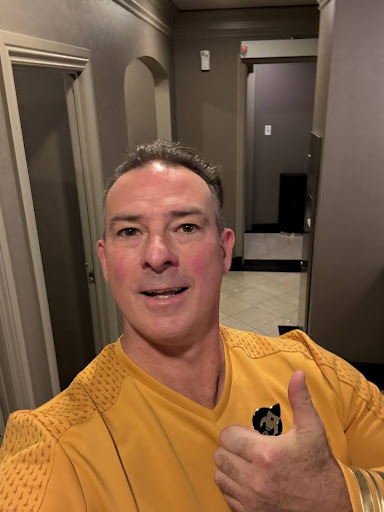
This is a strange, weird thing because the picture, and I’m going to share this and I’ll put it up on the screen here right here, is the picture that was put with it. And it’s of the owner of the business that I work with, his character name is Captain Dave, because we have him on a Starship Perfect Plumbing, and he’s wearing a Starfleet uniform with a real two-inch by two-inch, like a communicator badge on it. And they didn’t lean into it or didn’t have any personality.
Gary Bernier:
It sounds like a canned response with somebody’s name on it.
Matthew Burns:
It is a response. It is a canned read. I was like, “Oh man, I got to call Château Laurier, tell them, Hey, this one, I can help you with some marketing.” But this is what we’re talking about. This means that they didn’t actually care about that one response. Don’t get me wrong.
Gary Bernier:
And Matt, you touched on something there that is also one of our sore points. Don’t put canned responses out either to your five-star reviews or to your one-star reviews.
Matthew Burns:
Worse, your one star. Yes. And don’t ignore your one stars.
Gary Bernier:
No. Yes, you should respond to every review. Yes, you absolutely should respond to every review, and you should respond personally, especially if you know the person who gave you the review. You write them a nice note back because it’s a conversation between the two of you. It’s easy, right? Or, hey, I talked to the team, the guy that worked with you, and he said, da, da, da, da, da, and whatever. But as soon as that customer feels like you know them, you’ve upped your game, and the next person reading reviews for your business is like, “Man, they really care about people.”
Matthew Burns:
Absolutely. And here’s the thing: use common speech. Don’t use language that you wouldn’t use in common speech. If you wouldn’t respond to them, saying, “Oh my God, it was so awesome having you here.” Or, “Thank you very much for your enjoyable, pleasurable stay here at the Fairmont.” Those two things don’t read the same way. You don’t feel them the same way because it’s not common speech.
Gary Bernier:
“Hey, Captain Dave, we’re so happy you came in. Thanks for the nine out of 10.” Yeah. “Oh, man, we’re going to switch that out. We’re going to look at how we can turn this into a 10 out of 10, and maybe getting you back in here,” would be a better response.
Matthew Burns:
Exactly. No, listen, Château Laurier, they’re getting a ton of things, and I say a ton. They’re not. I think they’re getting five or six reviews a day.
Gary Bernier:
Well, this is the other thing, Matt. This is not a ton of work.
Matthew Burns:
It’s not.
Gary Bernier:
You do not get a ton of reviews every day.
Matthew Burns:
Nope. Nope.
Gary Bernier:
And you don’t have to answer the five stars the day they come in. You got it. So you can batch those. You can do them every couple of days. That’s not a problem. The one stars-
Matthew Burns:
Right away.
Gary Bernier:
Yes, you have to respond in a reasonable time frame. And the reasonable time fashion is reasonable for you to come up with a solution for that customer. You got it. Even if that’s, “Hey, call in and ask for me, and I’ll take care of you personally.”
Matthew Burns:
Absolutely.
Gary Bernier:
Right?
Matthew Burns:
Absolutely. No. And here’s the other thing, too. So I have a recommendation. So the question was, should I remove my one-star reviews? And I think unanimously we say, “No, don’t remove your one-star reviews.”
Gary Bernier:
Matt, there’s only one exception to that.
Matthew Burns:
Oh, okay.
Gary Bernier:
There’s only one exception. And again, even this one, it’s a fifty-fifty.
Matthew Burns:
Okay, go ahead. I’m curious.
Gary Bernier:
Every once in a while, you get the absolute jerk, the knucklehead.
Matthew Burns:
Okay.
Gary Bernier:
Now, if it’s very easy to tell the person’s just being a knucklehead, our recommendation is to leave it. But if it’s just nasty for the sake of being nasty and it’s just rude and offensive, then yes. Taking that one down, nobody needs to read that garbage.
Matthew Burns:
But if you failed, if you did fail, don’t take it down. Fix it.
Gary Bernier:
Yeah, right. Fix it. Fix it. But there’s always that one person who is absolutely ridiculous. But if they’re being so ridiculous, it’s obvious to the consumer, leave it because you have to trust the consumer, smart, and they’ll look at it and go, “That guy’s just a jerk.”
Matthew Burns:
Exactly.
Gary Bernier:
I don’t pay attention to that one.
Matthew Burns:
Exactly. Okay. So this is what I was trying to say. So that we don’t agree with taking down one-star reviews, and you’ve given us the kind of one exception, potentially, but we don’t take down one-star reviews. Instead, be remarkable, which means if you read all your five star reviews, because here’s what people don’t realize, five star reviews that are authentic and real and true and these people actually loved everything you did about everything you did for them, they’re going to say something on a regular basis.
If it’s this one weird thing that you do and you don’t realize you do and you don’t tell anybody you do, but you do it all the time. Or one specific tech or person within your organization is constantly getting recognized for this one thing, you can take that acknowledgement and go, Hey guys, Michael, Sally keeps getting recognized for doing this, but nobody else does this, and it’s not in our handbook. We’re going to put it in our handbook and elevate everybody’s status.
Now everybody gets to be remarkable, or, and this is Stephen Semple, Gary’s business partner, Wizard of Ads partner, he says to me, he says, Matthew, “If you’re not reading your one-star reviews and recognizing trends of bad behavior or bad service or bad communication, whatever it is…”
Gary Bernier:
The chinks in your armor.
Matthew Burns:
The chinks in your armor, and you don’t fix it, then you’re going to spend more time removing one-star reviews than you will be by answering the ones that come in and fixing your issues. So just be better, be remarkable. And then your five-star reviews will fly. You’ll never have to worry about being 4.8, right? And look, this is unsolicited, amazing advice from people who care about you. Otherwise, they wouldn’t even spend the time on the review.
Gary Bernier:
Hey, Matt.
Matthew Burns:
Yeah.
Gary Bernier:
In another episode, why don’t we talk about how to use your five-star reviews past Google?
Matthew Burns:
Oh, okay. You know what? Why don’t we record that right away? And then that way we don’t forget this, though. Guys, because we may, because we’re- We’re like that. Shiny objects. Okay. So guys, listen, thank you so much for joining us for this one. I hope this helps you guys with your review.
Gary Bernier:
Give us a five-star review for this episode.
Matthew Burns:
Please. We need a five-star review, thumbs up, a comment, and to share all of the things.
Gary Bernier:
Or give us a one-star, so we can respond to you.
Matthew Burns:
Oh, absolutely. You know what? Even better, go to matthewburns.com or garybernier.com and give us a one-star. We will definitely be commenting back. Guys, listen, thank you so much for continuing to join us. Remember, the Wizard Academy is our unofficial partner in this whole thing. We love that place. We just keep shouting them out because they’re brilliant. Go there, learn how to speak in natural English so that you can answer your five-star reviews really well. It’s a communication school. It’s a marketing school, a business school. Anyway, Gary, thank you, thank you, thank you.
Gary Bernier:
Thank you, Matt.
Matthew Burns:
Bye.

Each episode Matthew Burns brings in a fellow Wizard of Ads Partner to dispel misconceptions and offer actionable advice.
- Your Game, Your Rules: Why Copycats Can Never Catch You - September 22, 2026
- Afraid of the Camera? Your Business is Paying the Price - September 3, 2026
- The Unleveraged Asset EVERY Small Business Ignores - August 18, 2026