
Subscribe: Apple Podcasts | Amazon Music | Blubrry | RSS | More
From a horrible caffeine delivery system, Jim Folger takes a huge interest in making coffee better, and we thank him for it.
Dave Young:
Welcome back to the Empire Builders Podcast, where Stephen Semple, who’s the guy that you’re going to hear next, and myself, David Young. We talk about empires and how they’re built and what makes them tick. And if you’re listening to us in the morning, it’s totally appropriate for the topic that Stephen just whispered in my ear, which is Folgers, and immediately what popped into my head was the old jingle. The best part of waking up is Folgers in your cup.
Stephen Semple:
And Folgers is a dominant, dominant, dominant force in the coffee space. In the home ground space, the data that I was able to find, as they do close to 900 million in sales, is basically 27% of the market.
Dave Young:
My guess is that they in the past have been more than that, but the crafty roasting kind of people have probably been nibbling away at that over the years, but I’ll bet back in the ’70s or ’80.
Stephen Semple:
I didn’t go back.
Dave Young:
They were just a juggernaut.
Stephen Semple:
And I didn’t go back and take a look at that. But look, when you’re number one, you’re number one, right? That’s a big deal.
Dave Young:
When you and I were kids, nobody was grinding their own beans. You bought a big can of coffee and put it in a percolator. That’s what coffee was.
Stephen Semple:
But the interesting part is that we will talk a little bit about that campaign. The Best Part of Waking Up. That campaign came out in 1984, and prior to that, Maxwell House was actually number one. That campaign allowed them to surpass Maxwell House and become the leader in the space. So it was a very, very successful campaign.
Dave Young:
It’s one of those jingles. I don’t know if it’s out yet, but I did a copy of an episode of Sticky Sales Stories with Matthew Burns, and we talk about Winston and the power of the Winston Jingle, which can get into people’s heads. And if you were a kid before 1971, you still remember that jingle?
Stephen Semple:
Yes.
Dave Young:
And so Folgers, and gosh, you were inundated. You couldn’t escape the Folgers jingle.
Stephen Semple:
And there’s the power of the fact that it’s a rhyme. The best part of waking up. Like rhymes, as we know, have a rhythm and a power to them. We’ll come back to the jingle later, but let’s go back to the beginning.
Dave Young:
Let me put one more little plug-in for that episode with Matthew, because we talk about the scientific reason that audio is so sticky in your head. So it has to do with the brain and humans’ unique ability to process sound. And that’s the fun part. It’s more than just a story of, oh, this is how we sold cigarettes. So anyway, check that out.
Stephen Semple:
That’s awesome. That’s awesome. So as we all know-
Dave Young:
But wait till the end of the podcast.
Stephen Semple:
So as we all know, the Boston Tea Party was a thing in the United States, and in fact, it actually led to the growth of coffee being something that people started drinking in the United States. It ended up becoming a statement and a revolutionary idea. And coffee houses started to pop up both in the United States and around the world.
Dave Young:
But it was, “Damn that tea and the tax on it.”
Stephen Semple:
Yeah, that started getting things going, but-
Dave Young:
Which explains why you guys still drink a lot of tea in Canada.
Stephen Semple:
We do, but not as much as in other places. But the problem is, back in the 1850s, coffee was actually pretty gross. People buy big bags of green coffee, they take it home, they try to roast it like over a fire, and they have these crude methods for trying to grind it up, and they brew it, and it’s not good. It’s really just a caffeine delivery system. That’s really all it is.
And there are even old recipes. If you go back, there are old recipes talking about adding fish skins and eggshells to try to reduce the grinds that get into your coffee, which I mean, that can’t be great.
Dave Young:
If you’ve ever been to a history museum where they show you what civil soldiers carried around with them or the cavalry, they always had green coffee beans, maybe a little grinder, but yeah, cowboy coffee was… You just dump it in the pot, boil it over the campfire, and then maybe some egg, something, I don’t know, binds up the grounds.
Stephen Semple:
Yeah, yeah. Yuck is right. So Folgers’ origin goes back to the California gold rush, yet another company like Levi Strauss. And now Folger is the California Gold Rush. And as we know, the influx of people during the California Gold Rush was just mind-bending. So Jim Folger moves to San Francisco along with his two older brothers.
Now, Jim’s 14 years old, so he’s not old enough to work in the mines, but his brothers go work mining gold. And Jim starts to work for a company called the Pioneer Spice Mill, and he’s basically helping out the Pioneer Spice Mill now.
Here’s the interesting thing. If you go back to an early Starbucks logo, the early Starbucks logo talked about it being coffee, tea, and spices. When the logo was not green, but it was brown, and you go back to the very… And I always was like, well, that’s a really odd combination, coffee, tea, and spice. No, it’s not. The early days of coffee because there were certain spices that you roasted, and there were spices that you ground. Coffee was a natural for Spice Mills to actually start to produce because they could roast it, and they could grind it properly.
Dave Young:
What’s the other one that comes to mind? Chicory.
Stephen Semple:
Yes.
Dave Young:
Right. That was one spice that you could use. Is that a nut or a bark? I don’t even know what it is. But chicory was a replacement for coffee.
Stephen Semple:
So what ended up happening is Jim saw this coffee, and he tried it out. He went, “Wow, this coffee’s actually pretty good.” And so he started putting the coffee in the tins and taking it to the mine, like going to the mine and selling this coffee directly to the miners. So he was really the first to do this whole idea of pre-packaging the coffee in a manner in which it could be taken somewhere else.
Dave Young:
But still not liquid, just coffee that’s ready to be-
Stephen Semple:
Ready to be brewed and strained. But even that was an improvement. It was now properly roasted, and it was properly ground, and it stayed fresh because it was put in a can. So all of a sudden it’s this way, way better tasting coffee. Now, Jim works hard, ends up becoming a partner in Pioneer Spice Mill, and he gets the company to really focus on coffee. And basically reaches a point where Jim takes over the Pioneer Spice Mill.
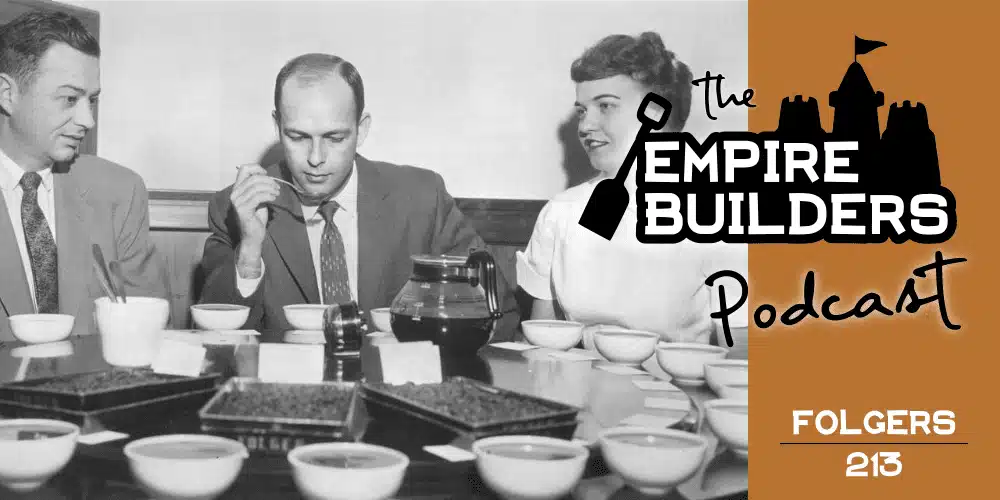
He joined in 1850, and then by 1859, he was basically in charge. But here’s the thing, he has this real dedication to quality. In 1880, he developed this whole idea of cup tasting, which is something that he took from the wine industry. With the whole idea that you’d have tasters tasting all the different types of coffee to really select which were the best beans, best grind, and best roasting to use in their coffee. He was really dedicated to this whole idea that it needed to be a quality product.
And then the other interesting innovation they did was in the 1900s. So we know in the 1900s, grocery stores started to become a bit of a thing, and they started basically in the eastern states, selling in grocery stores. But what they did was that one of their salespeople, Frank Atha, convinced them to do these really elaborate in-store displays. And I came across pictures of some of them. They were just remarkable displays that they would set up in terms of how they stack the cans. They would do free sampling and all this other stuff, stuff to really drive the sales. And they continue just to be innovative on that front.
But the part that I found that was really interesting about Folgers is this whole idea of they were really the first coffee company to come out and say, “Let’s make a quality product for people. And let’s package it up in a manner in which it’s easy for people to now suddenly take this into their home or their office or whatever and start to have a good quality coffee.”
Here’s the interesting thing, and the next one we’re going to talk about is Mr. Coffee. When you put together Folgers, Mr. Coffee, Gaggia, and Starbucks, you basically have the story of coffee. And we’ll talk about that in Mr. Coffee. So the funny thing is, we haven’t done in Nordics, people go back and listen to Gaggia, and they can go back and listen to Starbucks. They’re now in Folgers, and we’re going to do Mr. Coffee next. But today it’s estimated that Folgers is worth like $3 billion.
Dave Young:
Sure.
Stephen Semple:
And to me, whenever I’ve looked at the old logo of Starbucks, it always was like, that’s weird. Coffee, tea, spices. It just felt like it was this weird mix. And all of a sudden it’s like, no, it’s not. That’s what changed coffee when the Spice Mill started going, “We can roast it, and we can grind it.”
Dave Young:
We can make other hot drinks besides tea from things that are ground up.
Stephen Semple:
And because we’re able to roast it and grind it properly, we can make it good.
Dave Young:
Yeah. I’m all for good.
Stephen Semple:
Yeah, we can make it good.
Dave Young:
All right. I’ve got a coffee grounds question for you.
Stephen Semple:
Sure.
Dave Young:
You’ve done the research, so you must know. And I just had this happen recently. At Wizard Academy, we have one of those giant, I call it a funeral coffee pot. Basically, it’s this big coffee brewing percolating machine that holds like 40 to 50 cups of coffee. And you buy one of the big Folgers plastic cans of coffee. And the instructions call for so many scoops of coffee per cup. There’s no scoop in the thing.
Stephen Semple:
Oh, there’s no scoop in the thing. Okay.
Dave Young:
There wasn’t any scoop in the one… And so, how many coffee grounds are in a scoop? What kind of measurement is that? I wanted to see if it would stump you because I’ve seen the coffee.
Stephen Semple:
I think it’s a tablespoon.
Dave Young:
Yeah. Well, before I asked the question, I Googled it.
Stephen Semple:
And how much is it?
Dave Young:
And it’s about two tablespoons.
Stephen Semple:
Oh, it’s two tablespoons.
Dave Young:
Sometimes less, sometimes…
Stephen Semple:
Although that’s so helpful. Sometimes less, sometimes more is so helpful.
Dave Young:
Is there a more American way to measure something? So American. Usually, you compare a measurement as if you took two million of these and put them end to end, it would stretch the moon. That’s one American way to measure things, but to actually state it against a standard of measurement, it’s about two tablespoons. Well, why don’t we just say?
Stephen Semple:
Well, especially where I could understand why it would vary based on the coffee and things along those lines. See, and it’s funny, I remember they used to have a scoop in the can.
Dave Young:
Yeah. They used to have the scoop in the can.
Stephen Semple:
So I guess what they’ve done is a cost-saving measure, to take the scoop out of the can. But at least what they should do is tell people, “Here’s how much.” Yes.
Dave Young:
Yeah, if you’re buying Folgers by the gallon can, you’ve probably got a scoop somewhere. You probably know what you’re doing. We do this once or twice a year. And so gosh, if you let every little plastic utensil that came in a package, you’d be up to your neck in them.
Stephen Semple:
But here’s an interesting thing. We often talk about… And we’ve talked about this in past episodes, and so you can tell I don’t use coffee out of these cans, but from past episodes.
Dave Young:
Nobody else does either. I’ll tell you about that.
Stephen Semple:
Only 27% of the population. But here’s the thing, when we talk about eliminating friction, that instruction should be on the can.
Dave Young:
It’s on the can, but it doesn’t have the actual nature.
Stephen Semple:
No, but what I’m saying is to that precision, not just a scoop. Like, what’s a scoop? A scoop equals, right? Because that’s a friction item that frustrates people.
Dave Young:
If you’re trying to make 40 cups of coffee, you don’t have time to stand there and measure it by the tablespoonful. Like, oh, how many cups does it take? How many cups of coffee? So here’s the thing: we have a big class, a big event. We’ve got 40 or 50 people that we expect in the tower, and we don’t want to jam up the Keurig machine and the Nespresso machine. So we’re like, let’s make a giant pot of this funeral coffee. And people would rather stand in line one at a time if the Nespresso machine makes a cup of this coffee. So in the past year, I’ve made three or four giant pots of coffee and then poured them down the drain six hours later.
Stephen Semple:
And Nespresso, there’s another one that we’ve talked about in the past.
Dave Young:
Yeah, I know. We’ve talked about that one. I don’t know what episode that is, but check it out. You’ll understand why Nespresso is way better. I love this story of Folgers and-
Stephen Semple:
And Folgers is number one today, in the past, with The Best Part of the Waking Up campaign. And we’re going to talk a little bit about that campaign in the next one, Mr. Coffee. There’s kind of an interesting link together that Folgers really, really understood. That’s kind of cool.
Dave Young:
But the fact that they made a really much improved superior product for guys like miners that are going down and working underground was a product that was easier and better.
Stephen Semple:
Yeah, for laborers, miners. And then they leaned into that with creating this whole idea. They were the first company that had the cup tasters, and they copied that idea from wine sommeliers in terms of, okay, we’re going to do this thing to make sure that we’ve got a really high-quality, good grade of coffee.
Dave Young:
Well, and that ensures also that it’s going to be the same six months from now.
Stephen Semple:
Yes.
Dave Young:
You’re going to keep the flavor profile consistent for people. Brilliant. Yeah. Good job, Jim Folger. That’s what I say.
Stephen Semple:
That’s the story of Folgers.
Dave Young:
Thanks, Stephen.
Stephen Semple:
All right, thanks, David.
Dave Young:
Thanks for listening to the podcast. Please share us. Subscribe on your favorite podcast app and leave us a big fat juicy five-star rating and review at Apple Podcasts. And if you’d like to schedule your own 90-minute empire building session, you can do it at epirebuildingprogram.com.

- Can You Tell Me How To Get To Sesame Street’s 95% Reach? - March 11, 2026
- How Mr. Coffee Used Hutzpah and Joe DiMaggio to Brew Success - March 3, 2026
- Folgers – The Best Part of Waking Up - February 21, 2026