
Dear Reader,
“A Diamond Is…”
What popped into your head says something about you.
Get the attention of a group, say those three words, and pause.
Try it.
You’ll hear “Forever!” and “A girl’s best friend!” overlapping.
I’ve run this experiment many times, and the results are predictable.
It’s led me to this belief:
If a polling group were to run the experiment, the results would look something like this:
1. Women under 18 will say “A girl’s best friend!” more than 80% of the time.
2. Women between 18 and 22 will often blend the two answers.
3. Women over 22 will say “Forever!” more than 80% of the time.
Roll that around in your thoughts. Test it in your gut. Does it feel right?
Of course it does.
You understand that a woman of a certain age daydreams about the day when a handsome young suitor gets down on one knee and pops the question.
The young suitor’s hand emerges, clutching a small box. The young lady covers her mouth. She rises onto her tippy toes before bending weakly at the knees, hands still covering her mouth.
He asks, “Will you marry me?” and thinks to himself, “Will she love me… forever?”
She says, “Yes!” and thinks to herself, “Forever!”
You know this story, Dear Reader. Considering my audience, you’ve likely lived this story at least once.
And you know the source of the story.
But did you know this?
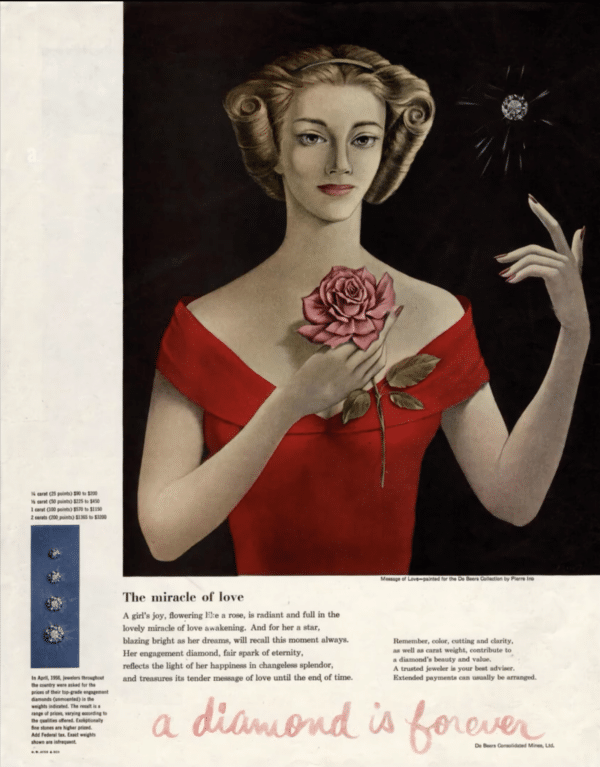
De Beers’ A Diamond Is Forever campaign was launched in 1948. Seventy-seven years later, it’s still alive and well — still in print, still on radio, television, and the internet… and still in your mind.
The power of a message is in the message, not in the medium.
Keep that in mind as Roy and I answer the question:
Is Print Dead?

Watch / listen above or read below.
Todd Liles: Welcome to the Wizard of Ads. Today’s episode is Print Dead. The purpose of the episode is to rediscover the unique advantages of print media in a digital-first world, emphasizing its ability to create lasting impressions, target niche audiences, and breaking through the digital clutter.
Roy, today we’re gonna dive into a topic that feels almost nostalgic, but really it should be rather fresh, and it’s this. It’s print media. More specifically, we’re gonna ask what critical role does it play today and can it still be powerful if the right message is applied? And the big question that we’re gonna ask is, is it dead?
So, the first section that we’re gonna dive in here today is the power of physical presence. And in an era of constant digital noise, print has the power to stop a customer dead in their tracks and create a lasting impression and build trust if it’s done well. So, Roy, I want to kick off with the big question. Is print dead?
Roy Williams: No, print will never die, neither will any of the other media. Print is ancient compared to digital. Print has literally been around since Gutenberg. And so, when you say is print dead, and is it an essential thing, is it ever a critical, vital thing? No. There’s nothing that you can’t ignore. As a matter of fact, Todd, more people try to do too many things a little bit instead of one thing with their whole heart.
And if you’ve got more money than what it takes to do one thing with your whole heart, then do two things, but three is always a mistake. Print can be the thing you do. It can be. Now, doing print right is very similar to doing online right, is… And I think it was Marshall McLuhan that said, the medium is the message.
Todd Liles: Yep.
Roy Williams: I have never understood that. I’ve had people explain it to me for 50 years, and I still am not sure what he was trying to say. I think it’s the dumbest thing I’ve ever heard. The medium is the medium. The message is the message. And my position is, when you’re using print, what’s the big advantage? The big one? People can reread it. They can look at it, think about it, read a little closer, and then start over and read it and process it and digest it.
Now, whenever you’re moving something past them or they’re not holding it in their hand. Now, when I’m talking about print, I’m talking about mailbox print. I’m talking about something that is physically at your house and you have to decide, am I gonna throw this away or am I gonna look at it? Because once they’re engaged and once they’re looking at it, they’re giving you their time not because you purchased it from them, the way that you do with television or radio or even with social media. It’s because you gave them something that they want to probe into a little bit, and so here’s what’s crazy.
In all the broadcast media, in anything using sight and sound or even just sound, the listener has to follow you at your pace. Right now, our viewers are following us at our pace. But when you’re reading something, you get to stop, contemplate it, reread it, go back and double-check something you read earlier just to make sure you understood it correctly and then process it. And I’m saying, so whenever you have something in a person’s hands, it still works. I mean, a lot of people are doing it incredibly effectively. A lot of people never quit doing it. Now, if it wasn’t working, there would be nothing in your mailbox this afternoon.
Todd Liles: Right.
Roy Williams: And so, yeah, print is awesome. It’s expensive, and I used to say that. I used to say, man, print’s really expensive. But now that digital has gotten as expensive as it is, now print’s actually pretty cheap compared to the cost of clicks these days. So I don’t know if I answered your question or not, but I did my best.
Todd Liles: No, you did. It’s absolutely… You answered my question. It’s not dead. This wasn’t in my questions, but it’s something that I’ve thought about and you’ve sort of risen it to the surface. One of the things that I love about print, whether it’s in advertisement form or whether it’s just a great book you pick up and read, is that, because it is unfolding and happening in the mind, it can have some of the biggest impact and greatest effects if it’s written well. You are unlimited in the world that you can create.
Which is also one of the reasons, on a side note, that I love radio so much, is because you can do very similar things with radio at a much lower cost to produce than you can with television. You can do those things with television. It’s just expensive to do. So, in one of your Monday Morning Memos that you wrote back on June 9, 2008, it was called A Comparison of the Nine Major Media. There was a statement. I’m paraphrasing it slightly, but you said that signage in particular, when it came to print, was some of the cheapest advertising money can buy when it’s also some of the most expensive to install.
Roy Williams: Yeah.
Todd Liles: I think that’s a pretty clear statement. But just to make sure that I understand, to me, what it sounds like is, putting up a billboard is gonna be expensive to install, but if it’s a great billboard, it’s cheap money on the dollar. Did I understand that right, or should I have taken that another way?
Roy Williams: No, you did. But I think of signage differently than billboards.
Todd Liles: Okay.
Roy Williams: Yes. And so…
Todd Liles: I think you unpacked that.
Roy Williams: Yeah. So, a sign is something on your building. And I say that expensive rent, expensive cost of occupancy is the cheapest advertising money can buy. Because the more you pay for a physical location, it’s because of the incredible traffic that goes by there.
Todd Liles: Yes.
Roy Williams: And if you have a building that is positioned. Now, let’s look at all the shopping centers you see in the world. There’s that row of buildings out in front, standalone buildings. And then back behind, there’s a big parking lot between them, and back behind are all these buildings in a long line. Here’s what’s interesting. The people back in the back, you know how they give people directions to their store? By naming the building they’re behind.
Todd Liles: Exactly.
Roy Williams: And so, everybody knows where those buildings are. They see those buildings every time they drive past, even if they’re not looking for them. Even if they’re not looking for them. That’s what I call intrusive visibility. When everybody in a region knows exactly where that is. Whenever you name, oh, you know where such and such is? Oh, yeah, yeah, yeah. They can see it. Why do they see it? Not because they’ve ever been in it, but because they drive past it every day.
Now, when you have that kind of a location and you have a very arresting sign, okay, you’ll become a household word and literally a landmark. I’m saying, now here’s what’s crazy. You pay for that sign one time. I don’t care how much you paid for it.
The number of people that are gonna see it and the number of people that you’re gonna become very, very familiar with, they’re gonna become familiar with you. They’re gonna know your name, they’re gonna know where you’re located, they’re gonna have certain impressions and feelings about you. And when it comes to real estate, Todd, whoever is sitting on the throne is obviously the king.
Todd Liles: Right.
Roy Williams: And when you have one of those high visibility in your face, big spectacular locations with this big monster sign and it’s really cool, people go, they’re important. They’re obviously important. And I’m saying, nope, they just got a great sign. Now that’s whenever I say signs are amazing. Billboards can be amazing, but you gotta pay for them every month. And I’m going, so that gets old.
Todd Liles: So, you reminded me of something that I have completely forgotten about, but Shannon and I were actually in the sign business for a small period of time. It was our first co-owned adventure, and I’ve never written about it and I haven’t talked about it in years and I’ve totally forgot about it, but I’m gonna tell you about it.
Roy Williams: All right.
Todd Liles: So, we’re Louisiana Tech. Shannon’s getting a degree in interior architecture and I’m getting my degree in speech communication, and I had a performing arts scholarship. So I would hang around Shannon, she’d hang around me, and all that time we were managing a pet store called A Touch of Nature. We had these shirts, big graphic design shirts.
And somewhere along the line, I don’t know if I was visiting Shannon or she was visiting me, but we would paint these sets and sometimes we would take projection screens. We’d project them against these large canvases, we would trace them and then we would paint them. Well, that along with what Shannon was doing, we got an idea and we went to Rebecca, the owner of the store, and said, hey, Rebecca, what if after hours you paid us?
And she had this great large brick wall that was just her brick wall. This building was probably 20 feet tall and that brick wall probably stretched for 50 feet. I said, what if you give us the first front of it, so a 20 by 40-ish sign, let us take the shirt and paint it on the wall and all these bright colors and we’ll charge you by the hour what you pay us now. Just we’ll do this extra. She said, okay. So we ended up doing hers and then we ended up doing about half of Ruston.
If they had a brick wall, they walked over to Rebecca, who did that, and Shannon and I went around painting signage, and we did all this stuff by hand. We measured it out. There was no ability to cast a projection screen. We had to trace it and stencil it. And I had totally forgotten about that, but at one point in time, we had about half the buildings downtown in Ruston that we had hand-painted, and the last one just came down like two years ago. They had left them up for that long until the buildings… Until they were sold. So they’ve lived for 20-plus years, and I’ve never considered it until right now.
Roy Williams: Oh, those are landmarks.
Todd Liles: Yeah.
Roy Williams: Now, to add a little point to what you just said, the big… What’s called, they used to call a rotary paint. Rotary meant that it moved from place to place. And paint means that it wasn’t a 30-sheet poster, which it goes up like wallpaper, but it’s literally a painted bulletin, and so they’re like 14 by 42, okay? Now, those are painted photo-realism because for years, they’ve had these gigantics on these big tracks and they’re motorized electric motors. Think of an inkjet printer, except it’s spraying paint, and so it’s computerized and it can do absolute perfect photo images, 14 by 42.
Todd Liles: Very cool.
Roy Williams: Well, now they’ve got those. They’ve got those. They sell them for 30 grand, and you can put them outdoors and level them up and paint up literally perfect, perfect fidelity, any detailed multicolor image you want at the press of a button. You move it inside a house, you can paint a feature wall, any mural you want on it. Perfect.
Todd Liles: I tell you what, for $30,000, that could be a very inexpensive startup…
Roy Williams: That’s what I’m saying. It’s an amazing business.
Todd Liles: Yeah, for sure.
Roy Williams: They just released them. Anyway, keep going.
Todd Liles: No, no, that’s wonderful. Thank you for that, Roy. So, I love the distinction that you give, and thank you for that clarity between signage versus a billboard. And whether it’s a sign on the side of a building, whether it’s beautiful yard signs that you put in the yard, they stay there for a period of time and you move them on. Now I get it. I get it. How can we leverage something once but be able to use it for extended long periods of time without paying monthly fees?
Roy Williams: Yeah, exactly.
Todd Liles: Smart. I love it.
Roy Williams: Truck wraps are like that.
Todd Liles: Truck wraps.
Roy Williams: Yeah.
Todd Liles: Absolutely. Roy, why is being intrusively visible so powerful in this world of digital distractions that we’re in?
Roy Williams: Okay. Whenever I say intrusively visible, if there is no emotion attached to your message, then it’s kind of pointless. But if your sign, if your store, if your presence, if the name of your company, if some element of what you do is sticky and it sticks in people’s head, and they attach a personality that they assume about you, your company, your product, your service, your brand, and then they also attach a place. Now, here’s what’s interesting.
When people are out moving around, when they’re driving through town, okay, they know where they are, if they live in that town, by what they’re looking at. And you know what? Everybody looks at all the same things. It’s not like you choose certain things to look at at a certain part of town and other people are identifying other landmarks. Nope, we all pick the same ones. And so, those things that in our peripheral vision are notable because of size, shape, color, texture, signage, lighting, whatever, it doesn’t matter what it is, okay?
Anything that is new, surprising, or different becomes a reference point. And when your business becomes a reference point or when your sign becomes a reference point, okay, then you occupy real estate in the mind of the general public. And I’m saying, yeah, physical location and great signage are media.
They are media. And you only pay for them once… And I’m going… And they have other purposes besides just advertising for you. They give you a place to work and show your products, and I’m saying I’m a big believer in expensive locations.
Todd Liles: No, I love what you’re saying. It makes me think of Jimmy Hiller, who, in the early days, I did a ton of work for. And when you would go to his location, it was a very large location, but it was like an old railroad repair shop center. Like, they’d bring rail cars in there, and they still had the big cranes overhead. So in a lot of ways, it was not very convenient for a heating and air conditioning company. But what it had going for it, was it was right there on I-65 in a part of Nashville where the traffic comes to a standstill at least twice a day for about an hour and a half. And he’s right up against it, and he had massive Hiller signs out that he didn’t have to pay rent on because they were his on his property.
Roy Williams: Wow.
Todd Liles: And it was an ideal prime location if you looked at it from that standpoint. He actually bent this not-great location to his will because he was going for location first related to traffic.
Roy Williams: Yep. Good move.
Todd Liles: Yeah. Very smart move. Let’s now talk about the problem with forgettable print. Here’s a little insight for the listener. Print that is ignored is a waste of money, and the medium alone doesn’t guarantee success. The message has to be just as powerful. Roy, what do you mean when you say the medium is not the message?
Roy Williams: Okay. The medium delivers the message, and I’m… As I said earlier, I’m always confused about how people say the medium is the message. And I’m going, I don’t know. The most people have ever been able to explain to me is that, well, you know if everybody’s watching TikTok, then TikTok’s the message. And I’m going, nope. The thing on TikTok is the message. TikTok is just a way of communicating little bits of information rapidly and continuing to punch the little dopamine button in our brain. My position is, hey, the message always matters more than the media that delivers it.
Todd Liles: Right.
Roy Williams: Period. The end. And most people are always looking for the magic vehicle, and I’m going, no, no, no, no. I don’t… I’m not that worried about what media you’re using. Tell me what you’re saying, and I’ll tell you how successful you’re gonna be. And so, this is where nobody likes to do that, because now it takes work, it takes judgment, it takes experience, and it’s not just a formula.
Todd, I’m sorry. Everybody wants a formula. Give me something actionable. Tell me what to do, steps one through five. And I’m going, I’m sorry. There is science in advertising, but it’s not a science. It’s an art that employs a handful of scientific principles. And I’m going, so this idea of, well, make it simple for me, and I’m going, you know what? I can say it to you, but I can’t understand it for you.
And I don’t mean to be a snob, but I’m telling you, the message is the message. The media that delivers the message, they’re different prices and they have different advantages and different weaknesses. There’s no bad media and there’s no best media. There’s just, choose a media for the love of God, but for above all, have a message that has the power to move the needle on the who gives a crap meter.
Todd Liles: I gotta ask you a question about it.
Roy Williams: Okay.
Todd Liles: It’s a very well-known billboard message and it’s…
Roy Williams: Yeah, I already know what you’re gonna say.
Todd Liles: Your wife is hot. Call such and such air conditioning…
Roy Williams: That’s not the one I was thinking about.
Todd Liles: Which one were you thinking of?
Roy Williams: “Does outdoor advertising work?”
Narrator: Oh, yeah. “It just did.”
Todd Liles: And so, it irritates me. You work to irritate me. No, I’m talking about your wife is hot. And periodically, you’ll see someone else has put this billboard up, and I can tell you that I don’t remember a single company below the line. What I do know, to the point that where, hey, I’m celebrating 24 years today with my wife, right? But every man’s gonna recognize an attractive lady.
They’ve gone from attractive lady to they shouldn’t put that lady on a billboard. They’re just trying to grab more extremes with the women they put on the billboard. And in my mind I go… Yeah, that’s clever. But I wouldn’t waste my money on it, but maybe I’m wrong. What do you think about that? Is your wife hot? Call such and such air conditioning…
Roy Williams: Okay. All of society, every person in society is a member of multiple little tribes. Okay. If you have a Jeep, you’re part of the Jeep tribe, probably. If you like to golf, you’re part of the golf tribe, et cetera. And there are tribes of people that just like low-brow humor. And you know some, I know some, and they just like low-brow humor… And it’s like, okay. And so if anybody thinks that’s funny, they go, oh, that’s great, I’m gonna use them. And I’m going, okay, it probably works.
Now, does it work with a lot of people? No, but it’ll always get enough feedback that it makes everybody feel like, oh, it’s the greatest thing we’ve ever done. Well, it’s the first thing you’ve ever done that people actually noticed. It doesn’t mean it’s a wonderful thing to do. It just means, yeah, it got you some feedback from some people. So, would I do it? No. But it’s because I know how to do a whole lot of other things that work a lot better than that.
Todd Liles: Let’s go to that then. We know that these things are like anything else. There needs to be a strategy connected to it. And I think I know your answer, because if the listener’s been listening now, they will know by this point that your answers are deep, well-thought-out answers that are tied to the client you’re talking about. It’s always dictated by strategy.
Roy Williams: Right.
Todd Liles: So let’s just jump ahead and say that the listener understands these principles and we’re not gonna unpack them.
Roy Williams: Right.
Todd Liles: Just assume that they’re actually the client.
Roy Williams: Alright.
Todd Liles: So, with that being in mind, what would be one thing when it comes to print, that when the time is right of leaning on what you’ve said, hey, probably two mediums, probably not more, maybe three, but probably two. What would be something that you’d go, hey, this will help you be remembered in a positive way? And maybe you actually have to lean into something you’ve done to answer that question.
Roy Williams: Well, okay. Let’s begin with the simplest basic equation. Now, this goes way back to David Ogilvy, who was the king of print when print was king. As a matter of fact, one of the only advertising books anybody needs to read, and it sounds like it would be too old to be relevant, but in about 1980 or something like that, David Ogilvy produced Ogilvy on Advertising, okay? And this is back when magazines were still just unbelievably powerful for brand building.
And he talks about long copy versus short copy, and he talks about the importance of the image or the illustration. Now, here’s the thing. Ogilvy and I agree, by the way, wholeheartedly. An image exists, whether it’s online or whether it’s a billboard or whether it’s a magazine ad or whether it’s a postcard in your mailbox or whether it’s a catalog or a brochure. An image exists to get you to read the headline, the subject line. The subject line exists to add meaning and a second layer of depth of symbolism to the message. Now, if the… See, as a matter of fact, let’s go back to the to the dumb deal, your wife is hot.
Todd Liles: Yeah.
Roy Williams: What we mean is, the temperature is really high in your house and she’s sweating… But whenever you say she’s hot, you think of this incredibly attractive woman. Okay. Double entendre. Now, here’s the point. It’s… That’s dumbass double entendre, but there’s also elegant double entendre that’s not sexual. And so, when you see the image and then you see a message tied to that image and it gives it a whole second meaning and it takes you down a rabbit hole, well, it causes a question. So, I call it the hovering question mark.
They want to read the opening line of body copy. Now, that’s the only reason that the subject line exists. The illustration or the photograph, the image, gets you to read the headline. The headline gets you to read the first line of body copy. Now, the first line of body copy has a purpose. Can you guess what it is?
Todd Liles: It gets you to read the next line.
Roy Williams: Bingo. And if you leave out the parts that people skip, they’ll read all the way through.
Todd Liles: Right.
Roy Williams: And did you know that right now what Google, well, actually YouTube, will reward you for more than any other thing?
Todd Liles: Watch time.
Roy Williams: Watching it all the way through. When a high percentage of people watch all the way into the video, man, YouTube gives you some love. And so the point is, leaving out the parts that people skip, keeping the story moving forward. That’s what makes a powerful print ad. That’s what makes a powerful print ad. It takes a really good writer. It takes a really interesting headline that is a twist or a reveal of a deeper meaning of the image. They’re always gonna see the image first and then quickly look at the headline, and if there’s a little bit of a, oh, that’s fascinating.
Todd Liles: Yeah.
Roy Williams: And then they look down.
Todd Liles: That’s good. Thank you.
Roy Williams: So those are… They’re symbolic to each other.
Todd Liles: Right.
Roy Williams: Symbolism is always part of what does this mean, what does this stand for, what does this represent? And so, I’m not going any further with that because we could take too long, but the point is that’s the way print works, and actually, that’s the way TV works, and to a degree, that’s the way radio works. And that’s always what you’re trying to do, get the attention and then hold the attention.
Todd Liles: Next segment that I want to talk about is when print beats digital. Despite all the digital hype, print can still outperform digital in certain contexts, if not many contexts, especially when the goal is building long-term brand loyalty. Roy, observationally here, I have noticed that really high-end brands still rely very heavily on print, even in this digital age. And I want to see why do you think these people that have money and knowledge still choose to invest so heavily in print?
Roy Williams: Okay. There’s a lot of subconscious elements to it. Believe it or not, when you’re talking about print, the thickness of the cardstock, the quality of the paper itself, the gloss, the sheen, and the images, the colors, and just the durability. Think of packaging. When you get something in a really elegant box.
Todd Liles: Oh boy, they do it right.
Roy Williams: Exactly. When you get something in a really amazing, elegant box, you just value what’s inside that box before you even open it. Well, print sends that same signal when you get something that’s really incredibly well done. And you’re going, man, these people are… These guys are serious. These guys are not playing. These guys are all in on their… The feel of their brand. Now, here’s what’s the big advantage. The question you asked, Todd, was, what advantages does digital have or does print have over digital?
Todd Liles: Yes.
Roy Williams: Well, here’s the big one. Okay. Targeting. Targeting. And whenever you say, okay, let’s say… I’m gonna talk about some of the obscure home services today, okay? Tree trimming. You know what tree trimmers look for? Houses with trees.
Todd Liles: I don’t know. Yeah.
Roy Williams: Big trees.
Todd Liles: Makes sense.
Roy Williams: Now, big trees tend to be in certain neighborhoods and not in other neighborhoods. And you know what’s funny about houses with big trees? They cost a lot more money than houses without trees. And so, especially big trees. And so big trees usually come with big lots and expensive houses, and people care about their trees, and they can afford to care about their trees.
So, do you want to target these people with Google, or do you want to go to where they are? There’s two ways to do that, Todd, and both of them work. The first one, ding, is to put something amazing in their mailbox. And if it only goes to the people who have big houses and big trees, it doesn’t matter how much you spend on delivering that sucker, does it? You know what the second one is?
Todd Liles: Yes.
Roy Williams: Door knocking. And when it’s done right, oh, it still works. I have a client that has built his home services business, Todd, to $30 million, and he’s never advertised. Door knocking.
Todd Liles: Yeah. Door knocking is very powerful. Shannon and I were… Going back to the tree things, we have a yard with a ton of trees, and every year, our trim budget is usually around $3,000 to $4,000. And historically speaking, we use the same person over and over and over and over again. Something different happened this year, and it happened in a way that made me go, huh, this is fascinating.
A new company knocked on the door, and this time when we opened the door, he introduced himself. He immediately pointed to his trucks, and out front, he had two utility trucks. They were all white except for the emergency type signage that you would recognize for a contractor that would work for the power lines, the municipalities. And they were municipality mulchers right there in the spot.
And I noticed these massive trucks going, huh, this is interesting. I don’t recall exactly the name of the business outside of the card that he gave me being on the truck. Maybe it was, but it had license numbers. But he pointed to those trucks and he introduced himself and said, we do the work for Buda, and he named several municipalities. He said, you can check that with these city managers. And today we wrapped up early, and as you can see, we have our utility trucks out there. We can trim and we can mulch. If you want mulch, we can put it down. If not, we can haul the mulch off. And I was so impressed with the fact that they had $200,000 worth of equipment out front.
Roy Williams: You know they’re not playing. Yeah. They’re not playing.
Todd Liles: Yeah. I said, when can you do it? He says, we can start now. We can finish tomorrow. And he described the work he was going to do. And I said, what’s your price? And he gave me his price. And I thought… I’ll see. I said, well, I’ll tell you what, my other guy does it for this. So he matched it. I’m like, all right, fine. Done. Do it.
Whether or not he could have done it for even less, after he matched, I was like, yeah, go ahead and do it. But in a way, going to your point, he knocked on the door. And man… You better have a really substantial physical piece to give me that same impression as seeing two of these utility trucks out front ready to go.
Roy Williams: Here’s the thing, and this is what I try to remind people of. Nobody wants to hear it, Todd. No one wants to hear it. Time and money are always interchangeable.
Todd Liles: Always.
Roy Williams: You can spend one to save more of the other.
Todd Liles: Right.
Roy Williams: You can spend time to save money, or you can spend money to save time. Now, which do you have the more of? Now, that guy, he’s got the $200,000 trucks and the bucket lifts and all this crazy stuff. And you’re going, okay, this guy’s geared up. Yeah. I mean, this guy’s for real. And so that’s super impressive. And he said, and we chose you. We’re at your house talking to you because we would like to work for you. And he pointed to his trucks, and you’re going, instant credibility. And he made a big impact. So, print can make a big impact. As a matter of fact, one of our partners, Stephen Semple, okay?
Todd Liles: Man, he’s talented. Yeah, smart…
Roy Williams: Listen, he spent $25 per delivery per address. Now, anybody that wants to read about this, if they want to read about high impact, it’s Marketing Outrageously by Jon Spoelstra. Jon’s a friend. I love his book. He even mentions me in it toward the back. But Jon is J-O-N, as in Jonathan. Jon Spoelstra. Now, his son is Erik Spoelstra, who, last time I checked, was general manager or coach of the Miami Heat, I think.
Todd Liles: Oh, cool.
Roy Williams: And so, I remember he was there whenever Shaq was still playing for the Miami Heat.
Todd Liles: Very cool.
Roy Williams: But anyway, Jon wrote Marketing Outrageously, and he talks about lumpy mail, and he put a rubber chicken in a tube. You know what I mean? Anyway, it’s a long story, but it’s an amazing book.
Todd Liles: That’s awesome. Thank you. In today’s ad segment, we’re gonna unpack one of the most famous print media campaigns ever, and it’s De Beers’ A Diamond is Forever. This campaign didn’t just sell diamonds. It created a cultural expectation around them, changing the way the entire world thinks about engagement rings. Okay, Roy, so today, in honor of it being my 24th wedding anniversary…
Roy Williams: Congratulations on behalf of all the viewers.
Todd Liles: Thank you so much.
Roy Williams: Congratulations.
Todd Liles: Well, I married a beautiful woman who makes me better in so many ways. And also because we’re talking about print, I wanted to bring the original A Diamond is Forever ad. And by the way, for those of you that wanna see it, you can see it over at toddliles.com/wizard. Go check it out. But I know that you’ve seen this ad forever.
And what’s interesting is, I said this weeks ago in front of my two young ladies, my wife and my daughter, right, and my son, too, but he just sort of looked at me. I said, hey, everybody, a diamond is… And I paused, and my wife immediately went, forever. You know what my daughter immediately said, they said it at the same time, they were overlapping with each other, she said, a girl’s best friend.
Roy Williams: Right, and they’re both true.
Todd Liles: Yeah.
Roy Williams: One is a song.
Todd Liles: Right.
Roy Williams: Yeah. Here’s what makes that interesting. It illustrates something I was trying to say earlier, but I said it very badly. So the image says one thing, and then the statement gives it an entirely different meaning, okay? Now, forgive me for being rambling and pedantic.
Todd Liles: No, please.
Roy Williams: For those that don’t know the difference between a simile and a metaphor, a simile: a diamond is like a song. A metaphor: a diamond is a song. And so, a metaphor is to say this is this, okay? And so to connect two things as being interchangeable and united. All right. And so, a diamond, strangely, is not forever. They’re easily destroyed. You can hit a diamond with a hammer and make it into dust that fast, and you can burn ’em up. If your house burns down, diamond’s gone, man. It burned up.
Todd Liles: Oh, I didn’t know.
Roy Williams: Diamonds… No, diamonds are fragile as hell. And so diamonds are not forever. True love is forever. And when they say, you don’t know that about diamonds. Nobody knew that about diamonds until I just told you. Oh, but they say, oh, well, diamonds, they know it’s the hardest substance in the world. And strangely, it does dissipate heat faster than any other substance on the face of the earth.
Todd Liles: Therefore, that’s why you’re iced out.
Roy Williams: But if you put a torch on a diamond too long, it burns up.
Todd Liles: I did not know that.
Roy Williams: Oh, yeah.
Todd Liles: I mean, it makes sense, it’s just carbon.
Roy Williams: Jewelers have to be super careful when they’re trying to re-tip the prongs on an engagement ring because the gold prongs wear down, the ring can fall out, and they have to put a little gold on it. They have to be really quick with that torch lest they burn up that diamond.
And now, here’s my point. Because you don’t know that a diamond isn’t forever, De Beers was to say, a diamond is forever. And so what they’re trying to say is, just like your love for her. And so they’re saying, oh, a diamond and my love, they’re interchangeable. And so they said, a diamond is forever. Nobody cares. You’re not focused on the diamond. You’re focused on the relationship, and if your relationship is forever, you should represent it by something that is also forever, but they’re not. And so, my point is, it’s good advertising, it’s bad science.
Todd Liles: I love it, though, because it’s very… I don’t remember the exact thing that you say, but it’s something along the lines of, how do you say it? Don’t let a lie get in the way of a beautiful story.
Roy Williams: Yeah. Actually yeah. And they say… Looks like, I don’t say it a lot, but I hear it said a lot, and I’ve always laughed at it. It says, never let the truth get in the way of a good story.
Todd Liles: That’s what it is. That’s…
Roy Williams: And never let the truth get in the way of a good story.
Todd Liles: Yeah. A diamond is fragile and will burn up under the heat.
Roy Williams: Yeah. It’s like… And you can…
Todd Liles: That’ll sell, won’t it?
Roy Williams: And you bang it with a hammer, you’ve instantly got a pile of salt. It just looks like salt, just little white dust. It’s like… They’re very fragile.
Todd Liles: So I think you’ve perfectly answered the question why this campaign actually worked for De Beers.
Roy Williams: Right.
Todd Liles: It’s very much… Also…
Roy Williams: It was never talking about the diamond. It was talking about your love for her. That’s what it was talking about. The diamond was simply a metaphor. Metaphor, metaphor.
Todd Liles: I love it. And probably some of the best people to do this so well by example is the original show, and I don’t know why I just drew a blank, we’ll have to edit this in. What’s the show with Don Draper?
Roy Williams: Mad Men.
Todd Liles: Mad Men. Yeah, Mad Men. He was always tying it to something else. So exceedingly well, you make it go, oh, I get it. It’s not about the diamond, it’s about the love. It’s not about the lipstick, it’s about the attraction. Very cool. Roy, thank you so much. This has been a great episode. In your thought here, what’s the one takeaway the listeners should take from today’s episode?
Roy Williams: Choose your message before you choose your media.
Todd Liles: Thank you so much. Well, print, folks, is not dead. It certainly is not. It’s just waiting for the business with the creativity and the courage to use it wisely.

We don’t just talk theory; we break it down so you can apply it. Join us as we reveal the secrets behind the most compelling ads ever created and help you wield the power of words to grow your business.
You can schedule a free call with Todd here.
- Why the Ads That Make You Feel Always Win (and Logic Rarely Does) - September 10, 2026
- Why Safe Brands Get Ignored and Bold Ones Win - August 26, 2026
- What Separates Ethical Persuasion From Manipulation - July 28, 2026