
Subscribe: Apple Podcasts | Amazon Music | Blubrry | RSS | More
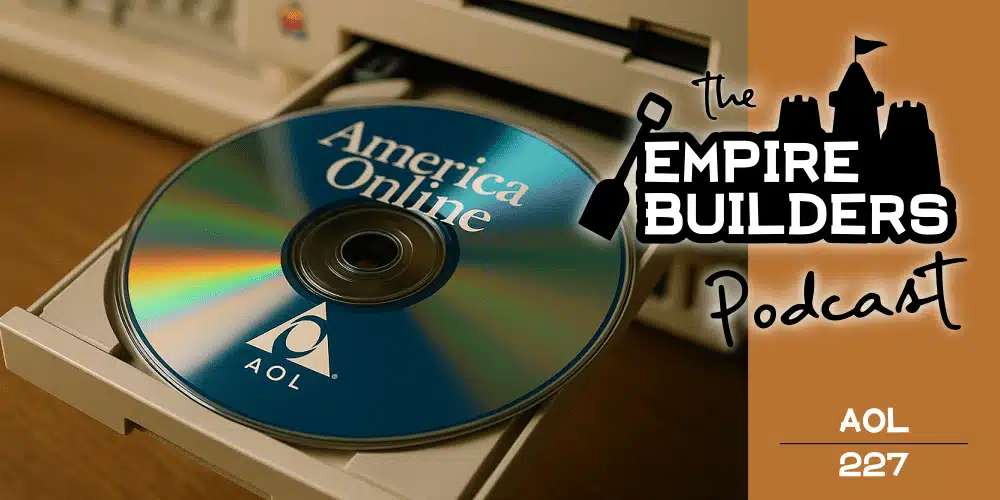
Did you know that at it’s peak America Online was responsible for 50% of all Compact Disc production in America?
Dave Young:
Welcome to the Empire Builders Podcast. Dave Young here alongside Stephen Semple. And Stephen, you’ve got mail.
Stephen Semple:
That’s right.
Dave Young:
You’ve got mail. You’ve got mail.
Stephen Semple:
Could you imagine? Could you imagine if it were still happening that way? You’ve got mail. You’ve got, you’ve got, you’ve got mail.
Dave Young:
It’d be all day long. I can remember in those early days when getting an email was like, oh, shit, I got an email. Or, somebody sent me an email, or they replied to one of mine. Oh my gosh.
Stephen Semple:
Yes.
Dave Young:
So AOL, that’s the… There was a time.
Stephen Semple:
America Online.
Dave Young:
There was a time they’d send out their what? CD-ROMs.
Stephen Semple:
Yep.
Dave Young:
You couldn’t reach into the seat back pocket of a car without finding one.
Stephen Semple:
And we’re going to explore that whole marketing campaign. But here’s the crazy thing-
Dave Young:
Cereal.
Stephen Semple:
All of it. Yeah. At its peak, one-half of CD production in the United States was dedicated to America Online.
Dave Young:
Oh my God.
Stephen Semple:
Isn’t that crazy?
Dave Young:
Say it isn’t so.
Stephen Semple:
I can’t. AOL was founded by Steve Case, William von Meister, Jim Kimsey, and Marc Seriff in 1983 in Brooklyn. And as we know, it went on to become one of the biggest names on the internet. And on January 11th, 2001, it merged with Time Warner, being one of the largest corporate mergers at the time, which actually turned out to be a disaster, but we’re not going to talk about that.
But back in the early days in 1983, let’s put it in perspective, because sometimes it’s really hard to think about these technological evolutions, but in 1983, Sony released the first consumer camcorder, and CD-ROMs were developed. And the first cell phone, remember the Motorola one that looked like it was a World War II walkie-talkie?
Dave Young:
Well, before that were bag phones. My first one was a bag phone.
Stephen Semple:
Yeah.
Dave Young:
The cell phone that you carried around with a giant battery in a bag.
Stephen Semple:
Exactly. Yeah. So that’s like 1983. And AOL did not start as AOL. It started as a company called Control Video Corporation (CVC), founded by Bill von Meister. And here’s what they created. They created this thing called Gamelink, and basically, it’s a modem that plugs into the Atari 2600 game module, and they would sell the modem for 50 bucks, and it was a $15 setup fee, and you could download games for a dollar over the phone.
That was the idea. This whole idea of the internet did not exist. It was this idea. Now, Steve Case, who becomes the main character in our story, worked for Bill, and less than a year later, in 1984, CVC is struggling because the video game boom has gone bust. Atari canceled the 2600 because only 3,000 units were sold. So the business is a bit of a tough space.
Dave Young:
This is a couple of decades before the boom, the bust?
Stephen Semple:
Yes. Oh, yeah.
Dave Young:
The bursting of the .com bubble.
Stephen Semple:
But this is how the video game business goes through this a little bit, softening. The board sidelines Von Meister and parachutes in Jim Kimsey, who’s a former military guy, and immediately he downsizes the business from a hundred people down to 10, including pretty much everybody in marketing.
But he keeps Steve Case, because Steve’s cheap, hardworking, and driven, and they become close. He mentors Case. Now, the first goal is to stop the creditors and keep the business alive. Now, the big advantage they have is that they have almost no assets. So essentially, they would say to creditors, “Go ahead, but you’re going to get nothing, so you might as well support us.”
Dave Young:
A couple of office chairs.
Stephen Semple:
Exactly. Now, it’s 1985, and one in 10 Americans owns a computer, but it’s rising. So it’s starting to get out there. CompuServe is around, but there’s not much else around for online. And CVC decides to build an online service for the most popular computer of the day, which is the Commodore 64. Remember the Commodore? I had a Commodore 64.
Dave Young:
I didn’t, but I had an old RadioShack one, and I think I just skipped over the Commodore at some point.
Stephen Semple:
There you go. Yeah.
Dave Young:
Somehow.
Stephen Semple:
So CVC changes its name to Quantum Computer Services. It’s not AOL yet.
Dave Young:
Yeah, yeah, Quantum.
Stephen Semple:
Quantum.
Dave Young:
Everything goes better with Quantum.
Stephen Semple:
Quantum. That’s it. Now, it’s 1985, and things aren’t on the web. Online is really these competing subscription services, mainly email, chat, and news. And each is separate. You can’t email across platforms.
Dave Young:
There would be bulletin boards you could dial up into. A BBS system. And then you could access whatever and you could leave me a message on the bulletin board, and if I happen to log back into it at some point, I might get your message.
Stephen Semple:
Yeah. That’s basically how it works. And it’s slow. To put it in perspective, if you were going to download a song, it would take three days to download a single song. So they’ve got this service for Commodore, and it’s $9.95 a month plus a usage fee. And online is still very niche. And they launched this Quantum link, which is email, news, and games. And in 1986, there were 10,000 subscribers. Not profitable, but enough to get some investors in behind it. But here’s the problem, you can also, not only is it only that platform, you can only use it on the Commodore 64. Each one of these things is designed for a specific computer.
Dave Young:
That’s why I didn’t use it.
Stephen Semple:
Yeah. And Commodore 64 is now losing market share. So they’ve got to find some other computer companies, and they decide to go with Apple just because of Steve Jobs and the way he sees the world. Although Apple’s struggling a little bit, too. The Mac’s weak, the Apple Two is struggling, but they still see an opportunity there.
So Case moves to California for a little while to really work on lobbying Apple, and he eventually gets him as a partner. He lands at Apple, and this moves Case up the chain and becomes an Executive VP at the company. And then they go on the launch services for PCs. Now, when Case looks at CompuServe, what he sees is something that’s faceless.
You sign on, and there’s that warble and all that other stuff. And he wants their service to feel friendly, so he wants a sound instead of a warble. So Case suggests a greeting that tells them when they get something like mail. So he hires Elwood Edwards for 200 bucks. Who does the voice of “Welcome, you’ve got mail.”
Dave Young:
You’ve got mail.
Stephen Semple:
Elwood Edwards is the guy who did the voice for that. So that’s cool.
Dave Young:
Yeah.
Stephen Semple:
So it’s October 1989. They now have 75,000 subscribers. Chat rooms are the ones that are popular and the most popular ones, I guess. What subjects are the most popular ones, Dave?
Dave Young:
Well, let’s see. It’s the internet. So porn, I’m guessing.
Stephen Semple:
Well, conversations about sex. Yes. Conversations about sex. So this is a concern for Quantum because they want to be family-friendly, and they’re afraid this could cause a scandal and all this stuff. And they’re thinking about shutting those chat rooms down until they take a look at the numbers. Because remember, more time on site, more money. And that’s where the time is being spent.
Dave Young:
Because they’re charging by the minute at this point.
Stephen Semple:
They are, yes. So they decide, you know what? We can keep these. CompuServe is the leader at this time. Now, Apple has canceled the service, and Apple owns the link name. So now they’ve got to find a new name. Case decides to hold a contest for the new name, takes a look at all the names that have been submitted, doesn’t like any of them, and decides to pick his own, which was America Online.
Dave Young:
I think he chose wisely, probably. It seems like it.
Stephen Semple:
Yeah, AOL. So it’s late ’91. They’re about to go public. They have 155,000 subscribers and $24 million in sales. CompuServe has now risen to 900,000 users. IBM Sears. Now, I didn’t realize Sears was a partner in Prodigy, but IBM and Sears had partnered together to create Prodigy, and they had more than a million subscribers. It’s the early ’90s. 15% of homes have computers. And this is an important part of innovation.
Dave Young:
Sure.
Stephen Semple:
There’s this whole idea of when you get to that 15% mark, you’re about to explode into mainstream. And about the amount of time it takes something to go from zero to 15, 12 – 15%, it’s about the same amount of time it takes for something to go from 15% to 80%. But the type of user changes. It’s no longer the early adopter. It’s now your mainstream consumer, but it’s also really rapid growth at that point.
Commodore is dying. Apple is struggling. PCs and IBM clones are winning. Modems are getting faster. And Case believes AOL is primed for online. It’s got good visuals, and it’s easy to use. Access to the web is still restricted to government, military, and research institutions, but a lot of people still look at AOL and see online as a novelty.
March ’02, AOL joins NASDAQ. Case becomes a CEO. And in 1993, Jan Brandt joined as a marketing executive. AOL is now struggling because growth is stalled. There are no more early adopters. Again, it has now moved into the mainstream. Things are a little bit different, and they now have to win a less committed computer user. It’s a different user. And IBM, the IBM Sears Prodigy partnership is now advertising on TV, but people really don’t understand what going online means.
Dave Young:
For sure.
Stephen Semple:
I even remember it wasn’t called surfing at first. It was the information super highway, and there’d be these advertisements for it, and you’d be like, what the heck are people talking about?
Let me layer something else onto you in 1992. I lived in, as I said, it’s not the edge of the earth, but you could throw stuff off the edge from there, in Western Nebraska. Okay? And all these services, even to access them, you had to have your modem dial a phone number. And the closest, cheapest call for me to make for my computer to dial that phone was a Denver number, which was long distance. And so, gosh, kids these days, they don’t know long distance,
Stephen Semple:
A long distance.
Dave Young:
It was expensive.
Stephen Semple:
Very expensive.
Dave Young:
So not only did you have the fees to use the service, you had to have your modem dial a long-distance call just to connect to it. And those calls weren’t often great. It just depended on what kind of line you got as to whether it was even a good phone line. So yeah, it was really weird getting online from the hinterlands basically, because all those companies had to put unique phone numbers in every market they were in. They would have to look at Denver and say, well, we need however many thousand phone lines to answer the phones when these modems call in. Crazy.
Stephen Semple:
And think about this, Dave, you’re a pretty early adopter of technology, and you struggle with it. So, imagine the mainstream consumer, and even what does this going online even mean? People weren’t sure about. So there’s all of this, what we like to call a marketing friction to doing things.
Dave Young:
And it was super-friction at the beginning. Yeah.
Stephen Semple:
And Jan didn’t come from a technology background, but what she did notice was that when she started to use it, she really enjoyed the experience. So what she needed to do was make it easy for people to try first, but it was hard to try. She wanted to make it easy. So she came up with the idea of mailing the discs with 15 hours of free use.
Dave Young:
Yeah, it’s a beautiful idea.
Stephen Semple:
All the public needed to do was put the CD-ROM into a computer. It would upload everything. And they get 15 hours to try it out. But of course, management is skeptical, because they’re technology guys, and this sounds really old school. What do you mean you’re going to mail out these CD-ROMs?
Dave Young:
Well, you can mail it to somebody a lot quicker than they can log on and download it at that point.
Stephen Semple:
Well, and not only that, again, people like, what is this thing? Even getting them to download, it’s like, well, what is this thing? So they wanted to do a test, mail out 200,000 discs. And as we know, in direct response, direct mail type things, a 1% or 2% response rate would be pretty good. But even looking at the long-term value of the customer, they’re like, if we can keep them around for a month or two, we’ve got an ROI. Well, the test kills it. They get 10% response. They get 20,000 users from the 200,000-piece mailer.
Dave Young:
That’s viable. You can do that.
Stephen Semple:
So they go all in direct mail. Now, there’s a little bit of a fear that the competition will copy this, which they don’t. By the time the competition wakes up, it’s too late. So in August 1994, they went from 75,000 subscribers to a million, and they flooded the nation with these CD-ROMs, as you were saying, you could find them everywhere. It ends up becoming 1/2 of CD manufacturing is AOL discs, which is just mind-blowing.
Dave Young:
They were inserted in magazines. They were in cereal boxes. Everywhere you look. Everywhere you look.
Stephen Semple:
But here’s the growth rate. 1994, a million subscribers. And here’s what I’m always saying to people. When you’ve got a marketing methodology that works, just do more of it. So they go from this one idea. 1994, a million subscribers. 1995, 4 million subscribers. Now, here’s the crazy thing: there are 18 million Americans online. They’ve got 4 million in 1995. The most used services basically become services like AOL. And AOL is the monster in it. Now, the ISPs, internet service providers, start to enter the market in terms of giving people actual access to the web.
And AOL presents itself as the gateway and now a web browser. In 1996, they hit a problem, though. 1996, they’re doing so many of these CD-ROMs that the marketing costs outstrips revenue plus the growth pressure starts putting pressure on the servers. And they’ve got to do a lot of investing in that. And the model changes to this unlimited use model, and online time explodes.
So they hit a bit of an issue, and they hired Bob Pittman as a new president from Time Warner because they needed to basically slash costs, and they needed to find new revenues. And they come up with this idea, this revolutionary idea, let’s sell online ads.
Dave Young:
Oh, yeah, that’s the start of it all, wasn’t it?
Stephen Semple:
It’s funny, we think that Google was the start of it all, but no, AOL was the start of it all. But no one’s interested. They have a really hard time until a company comes along, TeleSave, which offers low-cost long-distance calls, and wants an exclusive. They say, “I want to be your only advertiser.” And they pay AOL $100 million. And it’s a huge success. It generates a hundred thousand customers a month, which attracts other advertisers. 1-800-FLOWERS pay them $25 million. Amazon, which was only selling books at the time, paid them $19 million. And they really become the hot stock.
AOL and Messenger launch. They buy Netscape, they buy a bunch of other things. By the summer of 1999, they had 17 million subscribers. Again, if we go back, we look at ’95, they’re 4 million, a few years later, they’re 17 million. Just this explosive growth that comes from the CD-ROMs and selling advertising and things along those lines. A few years later, they did the disastrous merger with Time Warner.
Dave Young:
Gotcha.
Stephen Semple:
Because really, the lesson here to me was a couple of things. And the one is, so first of all, they wanted to create a better user experience. Let’s make it friendly. Everybody else was happy with the warble. They were like, let’s get rid of that warble. But the other thing was this whole idea of what’s the friction? And let’s eliminate the friction by giving people this CD-ROM in 15 hours to try it out. Let’s make it easy for somebody to try it. And look, they leaned into that for a long time. They were able to get years out of just that idea. And it’s funny how obvious that idea was, and yet no one copied them on it. This is a really simple idea, and mail it in.
Dave Young:
I remember there were so many that people were decorating their Christmas tree with AOL discs.
Stephen Semple:
Now, that’s the other thing they did.
Dave Young:
It’s like, I already have one, but I’ve got a dozen of them.
Stephen Semple:
But the other part is leaning into it as heavily as they leaned into it, actually did prevent anybody else from doing that idea. They were doing so many of them.
Dave Young:
I’d just be like, oh, me too.
Stephen Semple:
Yeah. There’s no way you could go into it. But it’s that whole idea of looking at it, going, okay, we’re now dealing with the mainstream consumer. It’s not the geeky person. What’s the friction? Friction’s trying it out. How do we make it easy to try out? Well, all you have to do is stick it into your computer.
Dave Young:
Once you have 15 hours of the internet under your belt, you’re not going back.
Stephen Semple:
You’re not going to go back.
Dave Young:
You’re not giving it up
Stephen Semple:
It was a sticky experience.
Dave Young:
Yeah, absolutely.
Stephen Semple:
It was a really, really sticky experience. And then when they needed new revenue, they were able to find it with the advertising. So we have them to thank for all of this online advertising. But in their day, AOL was the monster. Absolute monster.
Dave Young:
I looked just while we were talking. I looked at our Wizard Academy CRM, and I just did a search for people in it that have an AOL.com email, and there are still a dozen or so.
Stephen Semple:
Is that right? That’s crazy.
Dave Young:
Still their primary email.
Stephen Semple:
Still their primary email. That’s wild. That is wild. Well, and you think of it because then everybody else copied that. When Microsoft launched its email service, it was Hotmail, and then you got Gmail. Again, all of those ideas go back to the original AOL.
Dave Young:
Yeah. You give them 15 hours, and then you give them their own email address, so they’re not going to walk away from that. Now, people know them at that place.
Stephen Semple:
Yeah. Made it very sticky.
Dave Young:
That’s a cool story.
Stephen Semple:
And also made it viral. Because that was the thing that Microsoft figured out, when they created Hotmail, they didn’t have to advertise Hotmail because it got advertised when you got an email from someone. Yeah. But a lot of these ideas go back to AOL. AOL was the original creator of a whole bunch of them.
Dave Young:
It’s a cool story. You could study this one for a long time. And nothing makes me feel older than sitting here at your age, of my age, talking about something that when we were in our 20s, it would be the equivalent of somebody telling us about the things leading up to World War II. That long ago. Sit down, kids. Let me tell you about the internet before the turn of the century.
Stephen Semple:
Well, and people forget. I remember the early ads, and you couldn’t even figure out, well, what are people talking about? What’s this information super highway thing? I don’t get it.
Dave Young:
That always felt like a lie. It never felt like a super highway.
Stephen Semple:
Yeah.
Dave Young:
It was a back road. It was a dark alley.
Stephen Semple:
But AOL led the charge and made it mainstream.
Dave Young:
Yeah. Cool. Well, thank you, Steve. Did they have a sign-off sound? It was hello, and you’ve got mail. Did it say goodbye?
Stephen Semple:
That’s a really interesting question. I don’t know.
Dave Young:
Or did you just click and hang up your modem?
Stephen Semple:
I think it was just click and hang up the modem.
Dave Young:
And turn the TV back on. Yeah.
Stephen Semple:
For the three channels that you could get.
Dave Young:
That’s right. Yeah. Don’t worry, though, that super highway’s on its way with streaming. It took a while for that too. All right. Well, thank you for the AOL story and a trip down memory lane.
Stephen Semple:
All right. Thanks, David.
Dave Young:
Thanks for listening to the podcast. Please share with us, subscribe on your favorite podcast app, and leave us a big fat juicy five star rating and review at Apple Podcasts. And if you’d like to schedule your own 90-minute empire building session, you can do it at empirebuildingprogram.com.

- Google – Do No Evil… - September 14, 2026
- Chocolate Chip Cookies – An Empire??? - September 4, 2026
- Porsche – From Inexpensive To Luxury - August 25, 2026