
In the summer of 2011, with the housing bust still fresh, a trade magazine asked HVAC contractors how they had come through it. Frank Detmer of Detmer & Sons said his company refused to cut two things during those years: advertising and employee training.
Consider how easy the other choice would have been. Cutting is the decision nobody argues with. The banker nods, the bookkeeper nods, and the ad bill is the only line on the page that never argues back. The technician has a family. The truck payment is due on the first. And the ad budget just sits there, quiet, asking to be erased.
I get that call every time the economy wobbles: “Should we pause the ads for a while?” It is never really a question about ads. It is an owner at a desk at nine at night, looking at a slow month, wanting one thing he can control.
One contractor’s refusal proves nothing. So I went looking for the numbers. Somebody has been collecting them since 1927.
That year the Harvard Business Review printed a study by Roland Vaile, who had pulled the sales records of 250 companies and followed them through the slump of 1921. He sorted them three ways: companies that raised their advertising during the slump, companies that cut it, and companies that never advertised at all. By 1924, the companies that had raised their advertising were selling about a quarter more than the companies that had cut. The cutters stayed behind in all four years he watched.
You could say 1921 has nothing to do with you. Fair. Skip ahead.
In the 1991 recession, a researcher named Thomas Kamber tracked 822 companies and, unlike most people who study this question, he checked each company’s shape before the recession started. The companies that held or raised their advertising grew sales 7 percent in 1991. The companies that cut did not grow. By 1995, the gap between the two groups had widened to 25 percent. Four years of watching the other guy’s trucks drive past your shop.
Same result in 1974 and 1975. Same in 1981 and 1982. Gerard Tellis at USC reviewed every study he could find on the question in 2009 and summed them up in one line: “cutting back on advertising during a recession can hurt sales during and after the recession, without generating any substantial increase in profits.”
Read that last part again. Without any increase in profits. That is the part that should sting, because profit is the whole reason you cut. In a WPP study of 749 consumer businesses, return on investment during recessions fell 1.6 points for the companies that cut advertising and 1.7 points for the companies that raised it modestly. The cut bought nothing. It only felt like something. Companies that raised advertising by about half lost 2.7 points and won the most market share. Nobody gets the share for free.
Why doesn’t cutting a cost show up as profit?
Because advertising is relative. Your customer is not counting your dollars. She is counting who she hears from. Across 37 countries, when the economy dips one percent below its trend, advertising dips 1.4 percent. Everyone pulls back at once, and they all pull back for the same reason you want to. The company that keeps talking becomes the loudest voice in the room without spending a dollar more. The room went quiet around it.
Peter Field measured this on about 50 brands that advertised through 2008 and 2009. Brands whose share of category advertising ran well ahead of their share of sales grew their market share by 4.5 percent a year. Brands that let their voice shrink to their size, or below it, grew 1 percent.
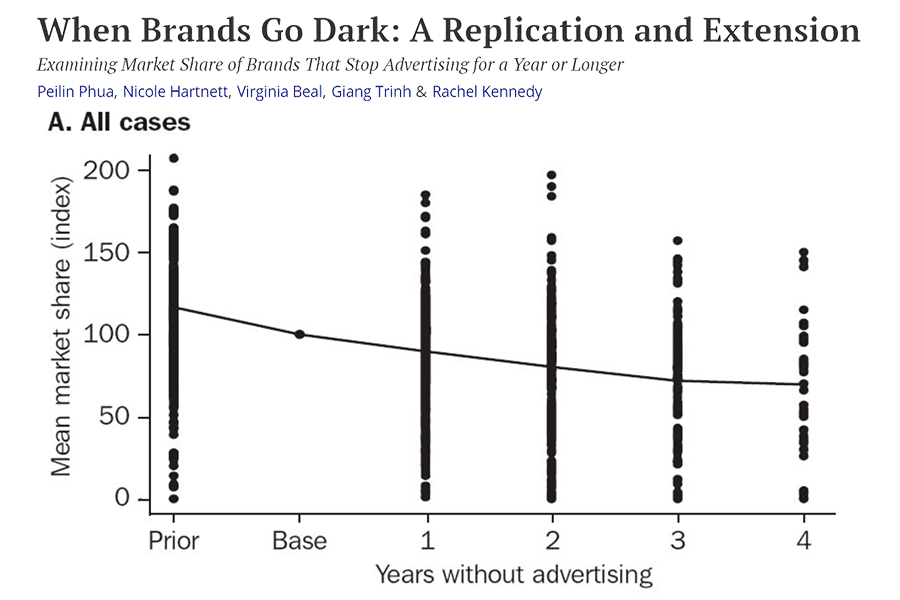
And the ones who go completely dark? The Ehrenberg-Bass Institute found 41 Australian alcohol brands, mostly beer, that stopped all advertising for a year or longer. Sales fell 16 percent after the first year, 25 percent after two, and 36 percent after three. They repeated the study on 365 American supermarket brands and got the same slope. The detail that should bother you is this: the big brands coasted. Large, growing brands often kept growing for a year or two after they stopped, running on memory. Small brands started sliding in the first year. Almost all of them.
You are not Budweiser. Nobody remembers your name on their own for two years. The woman whose furnace you fixed in 2019 is not disloyal. She is busy. When it quits again, she will call whoever she heard from last winter, and if that was not you, it was the company that kept its ads on while you waited for things to get better.
Now the honest part. Every study above was done on big companies or big brands. I couldn’t find a single study that tracked plumbers or HVAC contractors through a recession and compared those who cut their advertising with those who kept it. The closest thing is a 2009 survey of about 1,800 small firms in Britain and New Zealand, most with fewer than ten employees. More of them raised their advertising that year than cut it. The researchers classed the firms they considered vulnerable as those cutting advertising, prices, and headcount. The firms that did best sold more to their existing customers. A survey can’t say whether cutting made them weak or being weak made them cut.
The home-services data, however, can show that customers do not leave. When the housing bust erased almost a quarter of all home-improvement spending, maintenance spending rose slightly. In 2009, the typical design-build remodeler lost more than 20 percent of its receipts. The typical exterior replacement contractor lost less than 5 percent. The furnace still quits in a recession. The water heater still floods the garage at 2 a.m. The only question is whose number gets called, and who kept talking while everyone else went quiet decides that.
What kills contractors in a recession is cash, not silence. Harvard’s housing center tracked remodelers with payrolls from 2007 to 2012. Half closed or went back to working alone. Even among firms doing a million dollars a year or more, only about two in three were still operating five years later. So if keeping the ads on means missing payroll, cut the ads. Nothing in a hundred years of research says otherwise. But if you cut because the phone slowed down and the ad bill was the one line that wouldn’t fight back, the evidence says you are erasing the wrong line. You will not feel it this quarter. You will feel it three years from now, when the phone rings at your competitor’s shop, and you never find out.
Frank Detmer refused to cut two things. A hundred years of research can speak to only one of them, and every study points to the path he took. His refusal was not stubbornness. It was the one line on that page that the research says he was right to protect.
Sources
• Hall, J. R. “HVAC Contractors and the Recession,” ACHR News, June 20 and June 27, 2011.
• Vaile, R. S. “The Use of Advertising During Depression,” Harvard Business Review 5(35), April 1927, 323–330, as reported in Tellis and Tellis (2009).
• Kamber, T. “The brand manager’s dilemma: Understanding how advertising expenditures affect sales growth during a recession,” Journal of Brand Management 10(2), 2002, 106–120.
• Tellis, G. J., and Tellis, K. “Research on Advertising in a Recession: A Critical Review and Synthesis,” Journal of Advertising Research 49(3), 2009, 304–327.
• Biel, A. L., and King, S. “Options and Opportunities for Consumer Businesses: Advertising During a Recession,” WPP Center for Research & Development, 1990.
• Deleersnyder, B., Dekimpe, M. G., Steenkamp, J.-B. E. M., and Leeflang, P. S. H. “The Role of National Culture in Advertising’s Sensitivity to Business Cycles,” Journal of Marketing Research 46(5), 2009, 623–636.
• Field, P. “Advertising in a downturn revisited,” IPA webinar, April 2020.
• Hartnett, N., Gelzinis, A., Beal, V., Kennedy, R., and Sharp, B. “When Brands Go Dark,” Journal of Advertising Research 61(3), 2021, 247–259.
• Phua, P., Hartnett, N., Beal, V., Trinh, G., and Kennedy, R. “When Brands Go Dark: A Replication and Extension,” Journal of Advertising Research 63(2), 2023, 172–184.
• Smallbone, D., Deakins, D., Battisti, M., and Kitching, J. “Small business responses to a major economic downturn,” International Small Business Journal 30(7), 2012, 754–777.
• Joint Center for Housing Studies of Harvard University. “Improving America’s Housing 2011”; “Demographic Change and the Remodeling Outlook” (2017); Kermit Baker, “How This Recession is Expected to Affect Home Improvement Spending,” May 15, 2020.
https://www.jchs.harvard.edu/
https://www.jchs.harvard.edu/
https://www.jchs.harvard.edu/

In the wrong hands, Google Ads can become a dangerous and addictive drug.
We transform your Google Ads addiction into your Business Super Supplement. We
help make sure your brand’s personality is reflected in your Google Ads. Plus, we
continually refine your PPC campaigns for both efficiency and growth.
- The Two Things He Refused to Cut - October 14, 2026
- The Donut, the Hole, and Your Google Ads Budget - September 17, 2026
- Whoever Keeps Score Decides Who Wins - August 29, 2026