
Subscribe: Apple Podcasts | Amazon Music | Blubrry | RSS | More
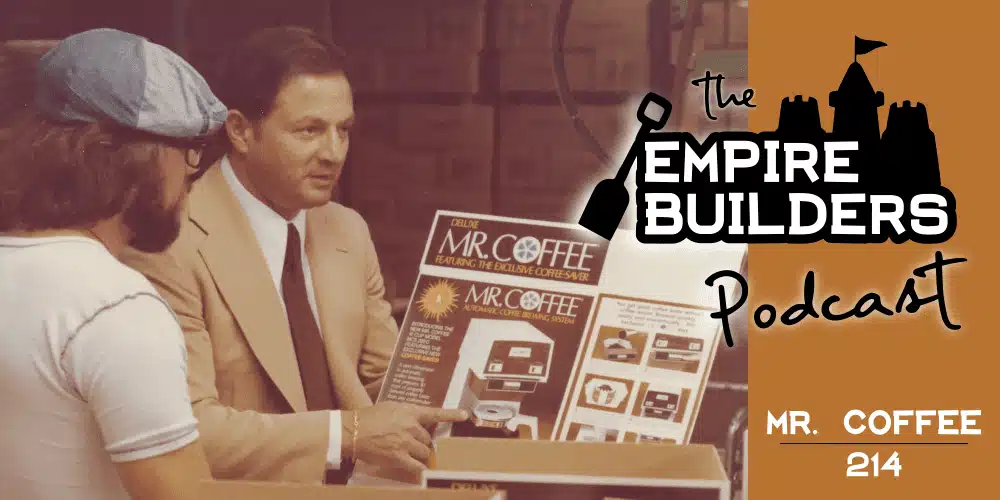
Vince Marotta realized that the percolated coffee at home was not as good as the coffee at restaurants. Mr. Coffee is how he fixed that.
Dave Young:
Welcome back to The Empire Builders Podcast. Dave Young, here alongside Stephen Semple, whispered in my ear that today the topic, keeping with our current theme, is Mr. Coffee.
Stephen Semple:
Mr. Coffee.
Dave Young:
That’s Mr. Coffee to you, sir.
Stephen Semple:
That’s it. That’s it.
Dave Young:
So we’re talking about the machine, right?
Stephen Semple:
Correct.
Dave Young:
Mr. Coffee is not a coffee brand; it’s a machine.
Stephen Semple:
That’s correct. It’s the homebrew coffee machine.
Dave Young:
Yeah. I’m trying to think of the associations that come to mind, and I’m thinking maybe one of their first spokesmen was Joe Garagiola.
Stephen Semple:
No, close.
Dave Young:
No?
Stephen Semple:
Joe DiMaggio.
Dave Young:
Joe DiMaggio, that’s right.
Stephen Semple:
So close. So close.
Dave Young:
Joe. I knew it was a Joe, and it was related to baseball.
Stephen Semple:
Well, that’s why I’m saying you were like, it was so close.
Dave Young:
I remember. Yeah.
Stephen Semple:
But yeah, it’s an interesting part of the whole coffee story. And as we talked about in the last one, Folgers, and I’ll tie it together at the end of this, if you actually take a look at Gaggia, Starbucks, Folgers, and Mr. Coffee, you basically have the story of coffee in America. And it was actually after I was doing the research on Mr. Coffee, I went, ” Holy smokes. Here’s how these four go together. This is really quite remarkable. So we’ll touch base on that at the end.
Dave Young:
Can I make a guess as to the evolution of this?
Stephen Semple:
Sure.
Dave Young:
Because remember, we talk about when you’re looking at innovation, take a product, take a service, whatever it is, and remove friction, make it easier and better. Before Mr. Coffee was a thing, you had these percolators at home. I remember my mom would… It’s a metal pot that plugs into the wall and has a little light on it, and then when it’s plugged in, it’s on, and when it’s unplugged, it’s off.
It had a metal basket, like a stem up from the bottom that would shoot boiling water up into the top of the percolator, and the little glass cap on the lid so that you could tell that it was working. And then that would just spray down on the coffee grounds in the metal basket and then drip into the hot water. And when enough time had passed, I’m not sure what the timing was on it, but then you had a pot of coffee. You waited until either the light went out or stayed on, or the bubbles, the percolating, quit happening. I don’t know how that worked. Well, see, now I’m-
Stephen Semple:
I forget how that worked.
Dave Young:
… going to go about that. But here’s the thing. The problem is, it seems to me like it took a long time for that to actually happen, and at the end of the process, you’ve got this metal basket full of wet, gross coffee grounds that you have to clean. You have to get rid of it. So you dump it in the trash, and now you’ve got wet coffee grounds in the trash, or you run it down the sink, and now you’ve got a plumbing problem. But those are problems that I think Mr. Coffee aimed to solve.
Stephen Semple:
Well, and there’s a problem you’re also not even talking about is the coffee was not as good because of the fact that the water was too hot. The ideal temperature to brew coffee is slightly below boiling, but to get a percolator to work, you’ve got to take the water up to boiling.
Dave Young:
The water’s got to hit boiling point at the base of the pot, and then shoot up the stem and rain down on the coffee. But it’s too hot.
Stephen Semple:
Correct. It’s too hot. So it’s actually not as good. So what happened is Vince Marotta was in Cleveland, Ohio, in 1960. The origin of this. And basically, he’s having coffee at home, he’s having his Folgers coffee at home made through a percolator, and it doesn’t taste as good as the coffee that he can get out at restaurants. So it’s the 1960s.
Dave Young:
Oh, like the Bunn machines, right?
Stephen Semple:
Bingo. His job was to deliver equipment to restaurants, including the Bunn-O-Matic.
Dave Young:
Okay.
Stephen Semple:
So it’s the ’60s. Dunkin’ Donuts in places like that are rising. The coffee that you can get out of these Bun-O-Matic machines is better. And so here’s Vincent at home going, my wife just brewed this pot of percolator coffee, and the stuff that I get when I’m out delivering these Bunn-O-Matic machines to restaurants is better. So what does he do?
Dave Young:
Figures out what makes it better.
Stephen Semple:
He goes to the Bunn-O-Matic and he tears it apart.
Dave Young:
Yeah.
Stephen Semple:
Now he’s not an engineer, so this is over his head. He starts ripping it apart and trying to figure out how to make a smaller home version of this? Now, he eventually does hire an engineer to help him create a prototype, and it takes him a while, since he started in ’67. In 1971, he had a prototype, so it took him about four years. And the big deal was, how do we deliver the water at just below the boiling point? That was kind of the big challenge. So it’s 1972, and this product makes its debut. And here’s the fun part. Do you know why they called it Mr. Coffee?
Dave Young:
Oh, is this the DiMaggio connection?
Stephen Semple:
Not yet.
Dave Young:
No? Not yet. Mr. Coffee. Because a guy could make it instead of his wife.
Stephen Semple:
So easy, even a man can do it.
Dave Young:
Even somebody as dumb as Dave could make you a cup of coffee that you would like to drink.
Stephen Semple:
There you go.
Dave Young:
No more of this cowboy coffee around the campfire.
Stephen Semple:
That to me is just kind of funny. It speaks to the world in the ’70s. Right? Mr. Coffee, so easy even a man can do it. That’s the reason why they called it Mr. Coffee.
But the sales are slow because if we adjusted for it, if it were being sold today, a percolator would’ve been about 12 bucks, and this would be about $240 in today’s dollars. So it would be buying a Keurig, right?
Dave Young:
Yeah.
Stephen Semple:
It’d be up there.
Dave Young:
Yeah, an espresso machine.
Stephen Semple:
Right. Sales were really slow. But here’s what Vincent believed: if he could get a trusted spokesperson, that would change everything. Now, Vincent, in a previous life, had become really close to becoming a professional baseball player. So he actually had connections in the baseball world. And so he tracks down the unlisted telephone number of Joe DiMaggio.
Now, I’m also going to say this, in the seventies, it was easier to track down athletes also because they did not have… And we went through one of our podcasts, the early days of sports management. And sports management was very new in the ’70s. It was actually a brand new idea. Remember the real first guy who had sports management was… Oh my God, the name just went out of my mind. Palmer. Arnold Palmer was really the first to have a sports management guy.
So Vincent tracks down the unlisted number of Joe DiMaggio, and he calls him up on the phone, and Joe basically hangs up on him, not interested. But he knows where Joe DiMaggio’s favorite restaurant is in San Francisco.
Dave Young:
Oh, wow. Okay.
Stephen Semple:
So he gets on a plane, flies to San Francisco, calls DiMaggio again, and says, can I buy you lunch at your favorite restaurant?
Dave Young:
Now Joe’s interested.
Stephen Semple:
DiMaggio was like, now he’s like, okay, it’s fine. Sure, I’ll do this. And DiMaggio did very few public endorsements. He really wasn’t into it. But you know what? They go out for lunch, and DiMaggio was later interviewed as saying, he really admired Vincent’s hutzpa, in terms of the fact that he just wouldn’t give up.
So DiMaggio endorses the product, and it explodes. 1977 sales hit 40,000 units a day. By 1979, sales were 150 million. And also, we see coffee sales increase at the same time. This also leads to an explosion in coffee sales, but here’s the number that blows my mind. In 1980, what percentage of homes had a Mr. Coffee in their home?
Dave Young:
Oh man. 1980?
Stephen Semple:
Yeah. In 1980, what percentage of homes had a Mr. Coffee in their home?
Dave Young:
Oh man. 1980?
Stephen Semple:
Yeah.
Dave Young:
I’m trying to… Is this sort of the peak, or is this…
Stephen Semple:
Yeah. Well, this is the peak in terms of, because keep in mind now you’ve got other people copying. In 1980, over 50% of homes had a Mr. Coffee machine. Not a home brewing machine, a Mr. Coffee. That is a phenomenal penetration.
Dave Young:
And they kept innovating. I remember the one that my folks had. It had a little, not an alarm clock, but a timer. You could load it up at night, and then you would have the coffee ready at 7:20 or whatever time you decided that you were going to be waking up and getting your coffee. You didn’t have to mess with it in the morning.
Stephen Semple:
So, 13 years after launch, it’s 1985, and the business is sold for $135 million and 1985 dollars. So Vincent, a guy who basically delivered equipment to restaurants, did pretty well.
Dave Young:
I wonder if he named his yacht Mr. Coffee.
Stephen Semple:
That would be a good name for his yacht, wouldn’t it?
Dave Young:
Yeah.
Stephen Semple:
But one of the things I said I would cover at the end of this is kind of how these four companies relate in terms of the story of coffee. And it hit me after Mr. Coffee. And in fact, now I think of it, there are really five companies. Folgers is basically the first one to sit there and say, let’s make coffee, let’s really focus on making coffee a quality product. Let’s roast it correctly, grind it correctly, package it in a way that it stays fresh, and deliver it so that people can make a decent cup of coffee in their home.
Dave Young:
They were the first to lift it above the level of a commodity.
Stephen Semple:
Correct.
Dave Young:
Okay.
Stephen Semple:
Make it a quality product. And the whole idea of cup tasting and all of that really sort of goes, we want this to be good, we want people to enjoy this. And also to be approachable. They didn’t make it for the hoity-toity class, as a working person’s product. So they were the first to do that. The next big innovation, if you think about it now, was maybe Dunkin’ Donuts, but really the next one was Mr. Coffee. From the standpoint of how we can now make this so that it’s easy for people to make this quality product at home? Percolator wasn’t great.
Dave Young:
Even a lawyer could do it, a male lawyer.
Stephen Semple:
So we go in for Folgers, and yes, the Bunn-O-Matic and all these other things happen, and then Mr. Coffee brings it home. Now, Gaggia, which is an old business, plays a role in this because Gaggia invented the modern espresso machine. With Gaggia and now Starbucks together, you have created that next evolution in terms of coffee consumption, which goes to this next level. It’s not a cup of Joe, it’s now become this premium drink that we all enjoy.
Dave Young:
We’re establishing not just drinking coffee as a beverage, but coffee culture.
Stephen Semple:
Correct.
Dave Young:
Yeah.
Stephen Semple:
When you really look at the history of coffee, if you go from Folgers to Mr. Coffee, then Gaggia and Starbucks, there’s the history of the coffee business in terms of the United States.
Dave Young:
Okay. Very cool story.
Stephen Semple:
And when a product hits 50% of homes having that product, I mean, wow, that’s a big deal. That is a huge penetration that very, very few businesses reach.
Dave Young:
Yeah. I mean, we see even in a local market, to reach 30% of your population as your market share is kind of unheard of. But hats off to them, they made a product that delivered, that was easy, and actually fairly long-lasting. Like man, a Mr. Coffee machine you can use the daylights out of it and then change to something else and stuff it under the cabinet and pull it out a year later and-
Stephen Semple:
It still works.
Dave Young:
It’ll still fire up.
Stephen Semple:
If anything, one thing you’ve got to do every once in a while, if it gets a little grungy, is you run vinegar and water through it, and it’s fine again. Right? Because it’s just the calcium that you’re getting rid of.
Dave Young:
What’s the mechanism for getting the hot water to the top, and is it slightly less than steam temperature? Is it just because it dissipates through the little rainmaker thing? It’s a plastic thing, and it cuts the… Because it’s still boiling water at the base to shoot it up the tube. There’s no pump or anything.
Stephen Semple:
You know what? I don’t know the answer to that question. I did not look into it. You get curious about these things, Dave.
Dave Young:
I do.
Stephen Semple:
And I’m like, I have no idea. I don’t care.
Dave Young:
I can tell you, well, I think that’s probably the same mechanism that Bunn had. If you have a column of water and you blow a few steam bubbles at the bottom, you’re going to shoot some of that hot water out the top, and it’s going to go through the diffuser and rain down on the grounds at a little bit less, enough less.
Stephen Semple:
And to me, probably the trick is how long the tube and things along that line.
Dave Young:
Sure.
Stephen Semple:
But I have no idea. I just drink the coffee.
Dave Young:
We’ll see. It is because it’s so simple that even a man can do it.
Stephen Semple:
That’s right.
Dave Young:
And the man doesn’t need to understand anything more than fill the water, put the coffee in the little filter thing, and then hit the go button.
Stephen Semple:
Right. And there’s one thing I almost forgot. We mentioned this back in the last episode on Folgers. So remember how Folgers was number two in the marketplace, and then-
Dave Young:
Oh, how they tied to Mr. Coffee.
Stephen Semple:
And then in 1984, the campaign, the best part of waking up as Folgers in your cup basically had them surpass. If you think about it, what Folgers recognized was that all of a sudden, when you talked about innovation, when you now suddenly had Mr. Coffee machines, and you talked about Mr. Coffee machines that innovated, where you could set the time.
All of a sudden, what happened was people were waking up to a cup of coffee. They saw that. Not only was this jingle powerful ’cause it was a jingle, and it was a rhyme. It actually was a change that we had happen in our life where people were setting that timer and waking up to coffee and enjoying waking up to coffee. So they actually tied into a cultural revolution that was already happening. And that’s why it was so powerful.
Dave Young:
And depending on where your coffee machine’s located, you might wake up before the alarm wakes you up to the smell of coffee in the air.
Stephen Semple:
Correct. Correct.
Dave Young:
So that’s great.
Stephen Semple:
But they notice that… We talk about great marketing, and we will notice this thread of something that’s going on in the world. Folgers noticed that and went, ” Isn’t that interesting? This is what people are now doing. And slid their product right into that idea. Isn’t that amazing?
Dave Young:
It really is. It’s smart marketing. And I also have to think that the notion of it wasn’t long before they came out with a product that was specifically made for drip coffee. There’d be Folgers grounds, and then there’d be one that says drip. Is there really a difference, or is it just the label?
Stephen Semple:
No. You know what? There is, and it’s in the grind.
Dave Young:
Just how do they grind it?
Stephen Semple:
Yeah.
Dave Young:
A little finer or a little less fine or whatever.
Stephen Semple:
A number of years ago, I got a really good grinder, and I’ve been playing around with grind, and grind actually does make a big difference to coffee.
Dave Young:
Okay.
Stephen Semple:
Yes. So you would grind it; for different machines, you do grind it slightly differently. Yes.
Dave Young:
So maybe a coarser grind stands up to the funeral coffee pot better than a fine grind, maybe. I don’t know.
Stephen Semple:
Right.
Dave Young:
Yeah. Okay.
Stephen Semple:
Yeah. So a drip grind, a percolator grind, and an espresso grind are different.
Dave Young:
And I think the fact that Mr. Coffee didn’t actually make coffee, they became this device, it allowed coffee makers to go along with them and say, oh, this works great in that product that you already have.
Stephen Semple:
Yeah.
Dave Young:
Perfect. I love this story.
Stephen Semple:
Isn’t that awesome?
Dave Young:
I’ve got to go refill my cup now. All right.
Stephen Semple:
There you go. Well, you’ve got 40 cups now that you’re going to make-
Dave Young:
No, I don’t have that machine at home. Ask me about my coffee habit, I am not sophisticated when it comes to coffee. I have a brand that I like, but there’s nothing sophisticated about it. It’s Cafe Bustelo Instant.
Stephen Semple:
Well, there you go.
Dave Young:
I boil the water. I love the taste of it. That’s it. That’s all.
Stephen Semple:
We’ll have to do one on the origin of instant coffee because that’s an interesting story in itself as well.
Dave Young:
All right. As the coffee saga continues. Thank you, Stephen.
Stephen Semple:
All right. Thanks, David.
Dave Young:
For bringing us Mr. Coffee.
Stephen Semple:
All right. Thanks, David.
Dave Young:
Thanks for listening to the podcast. Please share us. Subscribe on your favorite podcast app and leave us a big fat juicy five-star rating and review at Apple Podcasts. And if you’d like to schedule your own 90 minute Empire Building session, you can do it at Empirebuildingprogram.com.
- How Mr. Coffee Used Hutzpah and Joe DiMaggio to Brew Success - March 3, 2026
- Folgers – The Best Part of Waking Up - February 21, 2026
- Red Bull’s Branding Duality - February 12, 2026