
Dear Reader,
BAT CHILD FOUND IN CAVE!
That headline screamed across the cover of Weekly World News in 1992.
“He is not a boy or a bat. He’s a Bat Boy! We suspect that the mother is a local.” – Dr. Ron Dillion
The story was pure hogwash. But that headline sold over a million copies and gave Bat Boy a life of his own — thousands of articles, a cult following, even a musical.
Why did people buy it?
Because it did the one job every headline must do: it made you want to read the next sentence.
A headline isn’t there to sell. Its purpose is to propel — to pull the reader forward with a hovering question mark that demands resolution.
In this episode, Roy and I talk about the serious business of headlines. Why they work, why most don’t, and how absurd or surprising lines can spark curiosity strong enough to carry your audience to the very end.

Watch / listen above or read below
Todd Liles: Roy, welcome to another Todd Liles and the Wizard of Ads. Today we’re gonna start episode 24. And episode 24 is titled ‘How to Write Headlines that Grab Attention’. Now, I want the listener to know right at the top of this episode that when this episode is done, if they’re listening to this weeks after it’s over, then immediately go listen to the next one, because episode 25 and this episode are gonna play together.
Today we’re gonna talk about headlines that get attention, and then we’re gonna talk about ads that get results. So with that being said, let’s jump into it. Okay, Roy?
Roy Williams: Good.
Todd Liles: You ready to have a good episode?
Roy Williams: Good, good, good. Yes.
Todd Liles: Me too. All right. Roy, I’ve heard you say, and I think you were quoting either David Ogilvy or Joe Sugarman, that the purpose of the headline is to get the first sentence read. And that the purpose of the first sentence is to get the second sentence read. Which means a headline should have the intention of getting you to take an action, which is to continue to read. 
So today’s show, we’re gonna be deriving content from Joe Sugarman, the Adweek Copywriting Handbook. We’re gonna be taking excerpts from David Ogilvy’s work and, of course, your Monday Memos. Now, if the listener wants to find your Monday Morning Memos that I’m referencing today, you can find that at mondaymorningmemo.com and the ads today are Deconstructing a Great Ad, Advertising Oversimplified, Random Entry, which by the way is a list of random entries hundreds of entries long, but it’s one of my favorite go-to sources, Roy, and then Brad Pitt, Ron Howard and Me. How about that for a headline?
Roy Williams: Wow. Two things I want to say.
Todd Liles: Yes.
Roy Williams: I need to prepare people.
Todd Liles: Please.
Roy Williams: That mondaymorningmemo.com is a 20-plus-year-old website. It’s dusty, it’s out of date, it’s obsolete, it’s absurd, because it’s just basically an archive for me to have a digital repository where I can store digital format of memos of decades. And so it is not a lead-gen device for me. It’s not about business. It’s actually if nobody knew it was there, that’s fine. I have about 8,000 quotes stored there of things I’ve transcribed out of books and it’s actually a resource of material for me so that I can just with a few keystrokes find in my own archives of nearly 40 years what I’m looking for.
So they’ll say, “This is the worst website I’ve ever seen.” I’m going, “Yes, I know.” It’s like… And it’s something I just don’t care about. So when you mention my website, I just need to give people that disclaimer because my business does not depend remotely on a website.
Number two, you said that the headline, the job of the headline is to get you to the first line of body copy. The job of the first line of body copy is to get you to read the second line of body copy and then you should leave out the parts that people skip and people read all the way to the end.
The one thing we forgot to tell them, if you’re talking about billboards or magazine ads or a lot of online stuff, the job of the illustration, the job of the photograph is to get people to read the headline. And so the only reason to have an illustration or a photograph is to get people to read the headline.
Todd Liles: That’s such a good tip.
Roy Williams: That’s why they also always have a pretty scantily clad girl selling products like brake pads for cars or clutch pedals. And it’s like they don’t have anything to do with each other. It’s like, yeah, the only job of the image is to get you to read the headline. The job of the headline, first line, second line, leave out the parts that people skip. Keep going.
Todd Liles: No, that is such a good tip. Okay, I’m gonna take a rabbit trail.
Roy Williams: Okay.
Todd Liles: And then we’re gonna talk about the rabbit hole.
Roy Williams: Then we’re gonna get back on the plan.
Todd Liles: Yeah. So this morning when I was looking through Facebook, I’m flipping through and there was a post from our friend Ken Goodrich. And a beautiful woman running ice down her lips and she’s clearly perspiring.
Roy Williams: That’s his wife, by the way.
Todd Liles: I know. So you’ve seen the ad, right?
Roy Williams: He sent it to me. Yeah.
Todd Liles: Obviously, he did the really true first “Is your wife hot?” ad, but it’s almost on the verge of like, “Uh, Ken, this is a little far.” But I did stay in there and keep reading, but I don’t know if I would have if I didn’t know that Ken was posting. I clicked and I read what Ken wrote, and basically Ken said, “This was a terrible idea, but I did do it. And that is my wife and she is beautiful. So I’m basically saying I’m honoring my beautiful wife.” But yeah, I’m probably gonna wait for the next sentence on that ad. That’s all I wanted to say.
Roy Williams: Well, and when he asked me what I thought about it, I told him the truth. I said, “Whoever shot the ad knows how to fill the frame,” because the shots are all much, much closer and exclude way more than the average videographer would shoot. And it’s called filling the frame. And so if you get three or four steps closer so that you’re only seeing a piece of the image and you’re imagining enormous amounts that are off the left and the right frame line, the upper, the lower frame line, so everything that you don’t see inside that image, you have to fill it in in your imagination. And triggering the imagination is what good headlines are all about.
Todd Liles: Yeah. So I want to jump back real quick. You talked about the Monday Morning Memo, and from a user experience, because I go there often, it’s actually great. The search engine is great.
Roy Williams: It works okay. It’s just ugly and hasn’t been updated in 20 years.
Todd Liles: I hear what you’re saying, but I would tell you it’s classic. It feels like you are reading…
Roy Williams: You’re so gracious. You are just so gracious.
Todd Liles: No, no, no, I’m not being gracious because I’m about to tell you the one thing I would fix on it.
Roy Williams: All right.
Todd Liles: It is very classic. You can find what you need to find. You can read it. It’s easy to read. It’s not filled with things that are distracting. The only thing I had to learn was how to find the rabbit hole. That was confusing to me.
Roy Williams: Okay. It’s a secret.
Todd Liles: It’s like the hidden menu.
Roy Williams: Because it’s for self-selected insiders. Only about 3% of the people that read the Monday Morning Memo even know there is a rabbit hole.
Todd Liles: Yeah, so unpack that and then we’ll get to the topic.
Roy Williams: Okay. So because you put me on the spot, I will answer the question.
Todd Liles: Okay.
Roy Williams: Lots and lots and lots and lots of hidden content, page after page after page after page every week in the rabbit hole. And that is the reward for a person being a self-selected insider. In other words, if you found it, that means you’re really digging and it’s kind of a secret.
And so anytime I want to do something and I have a… It’s because I’m a tacky human being, but I have a thing that I say a lot: “No randos in my canoe. No randos.” I don’t want strangers thinking I owe them explanations about things and free consulting simply because they found out where I hang out on Friday afternoons. It’s like, nope.
And so the self-selected insiders are a tribe, a self-selected tribe. And anytime I’m gonna do something awesome or give away a bunch of stuff or have a party, the only people that get invited… If you’re reading the rabbit hole, then you’re one of this relatively small number of people that know if you want to fly to Austin, what we’re getting ready to do is free and it’s gonna be a lot of fun.
And I’m gonna pick up the tab. And so you don’t do that and tell all the randos in the world. You do that for the people who have been following your stuff for a long time and they feel like they have a relationship with you. And every once in a while you say, “Hey, everybody, let’s get together.” I don’t put it in the memo because way, way, way, way too many people read the Monday Morning Memo. The rabbit hole, the fact that you found it is delightful. And if you decide to cut this part of the conversation out of the video, that would be fine. If you want to leave it in, that’s okay too.
Todd Liles: Okay, well, thank you for that. I have a little clarity now.
Roy Williams: All right.
Todd Liles: All right, let’s get into the first section of today, which is the headline’s job. Now, Roy, when you first heard it, either from Sugarman or from Ogilvy, that the idea here is to get the person to take the next action, did it immediately click? Or were you already doing it? Or was that one of those aha moments or were you like, “Nah, of course”?
Roy Williams: No. What happened is it was said more plainly. I often, as you know, get sidetracked and make too big of an answer for too small and simple of a question. And so Sugarman and Ogilvy can both say things very succinctly, very tight, very…
Todd Liles: Pithy. They say things pithily.
Roy Williams: I write far better than I speak. I speak very recklessly. I write very carefully. And so I can write like that, but I don’t ever… I don’t have the economy of words when I’m talking. And so that brief, tight economy of words where the job of the illustration, the job of the photograph is to get people to read the headline. And I say subject line because when we say headline, it’s the subject line of an email, it’s the opening line of a radio ad, it’s the first mental and emotional image in a TV ad.
And it doesn’t have to be the opening thing. It’s just the first thing that really hits you hard. See what I mean? That first big moment when you go “pow.” And this is gonna be within the first three or four seconds. But the point is, don’t think headline means print. Headline simply means attention getter.
Todd Liles: Yeah, the attention getter.
Roy Williams: And so what was the question? I’ve already confused myself.
Todd Liles: Well, it’s okay because I have another question.
Roy Williams: All right. Go ahead.
Todd Liles: And it’s one that I was actually building to, and I think we’re there.
Roy Williams: Good.
Todd Liles: When you’re writing your ad, do you write the headline first or do you find the headline once the ad is written? How do you start?
Roy Williams: Well, every writer has their own technique. I start with an opening line, and then I will decide what it’s gonna be about, what I’m gonna be talking about, and what the title is gonna be after I’ve written the opening line. So the opening line comes before anything.
As a matter of fact, when you’re writing dialogue, the only thing you have to understand, let’s say there’s gonna be two characters. And if you know these two characters, you just sit there and you wait for one of them to say something. Doesn’t matter what they say. And when I say, whenever you create characters, they actually exist in your imagination. They actually are there. And you can sit and listen to them. And you have one character say something that leaves and is what I call a headline.
A headline should leave the hovering question mark. In other words, it’s a mystery that needs to be resolved. It’s like when Bobby says, “How much should a hamster weigh?” And you’re going, “Hang on a second. You can’t not read the next line.” See what I mean? It’s like the question is so… It’s like, “I need some context here.” “What do you mean, how much should a hamster weigh?” So you’re the reader, the listener, the viewer. Oh, you’re not turning the channel right now. And so that’s what I call the hovering question mark. The job of the opening line or the subject line is to cause a person to continue reading so they can solve that mystery.
Todd Liles: That’s wonderful, Roy. And it takes me to the second segment here, which you’re already doing it, which is surprise in Broca’s area. You write about this in Deconstructing a Great Ad, and then you just literally gave us an example: “How much does a hamster weigh?” Because the quote that I think…
Roy Williams: “How much should a hamster weigh?”
Todd Liles: “How much should a hamster weigh?” Right? What you’re doing is you’re creating surprise in Broca’s area. So you win Broca’s undivided attention when you break a pattern.
Roy Williams: Right.
Todd Liles: So, Roy, how does that concept of breaking a pattern apply to that headline? Say the headline again, ’cause I can’t…
Roy Williams: “How much should a hamster weigh?”
Todd Liles: “How much should a hamster weigh?” Well, Mr. Jenkins, how much should a hamster weigh? Right? So you’re breaking a pattern there.
Roy Williams: Yeah, yeah. So here’s the ad. “Mr. Jenkins?” “Yes, Bobby.” “How much should a hamster weigh?”
Todd Liles: “Mr. Jenkins?” “Yes, Bobby.” That’s the cue.
Roy Williams: Yeah. “Mr. Jenkins?” “Yes, Bobby.” And he’s got the phone up to his ear. Bobby’s on the phone with somebody. “How much should a hamster weigh?” And he says, “What?” And he goes, “These people got one that’s up to 27 pounds. You think maybe it’s a wolverine?” And so you’re six, eight, seven seconds into the ad, and you already are going, “Mr. Jenkins?” “Yes, Bobby.” And you know Bobby’s gonna say something. “How much should a hamster weigh?” “What?” “These people have got one that’s up to 27 pounds. You think maybe it’s a wolverine?” And he says, “I don’t know, Bobby, but I do know this.” And then all of a sudden…
Todd Liles: There we go.
Roy Williams: You’re with me?
Todd Liles: Yeah. Because that’s where I was going next. You create this environment of surprise, and the person goes, “What in the world?” And maybe it’s the first time they’ve seen this ad. If I’m deep into it, I’m looking forward to what’s coming next. But if this is the first time that I’ve ever… “Maybe it’s a wolverine.” It’s like, okay. So how do you balance that surprise? “I got your attention, and now let’s move into clarity and a lack of confusion for the purpose why we’re here.”
Roy Williams: Okay, now, you’ve mentioned Magical Worlds Communications Workshop, one of the three-day classes at Wizard Academy. Daniel Whittington teaches that class for the past several years and does a fantastic job and has taken it to a whole new level. But I will tell you one of the exercises that nobody believes they’re gonna be able to do, but at the end of three days, everybody does a staggeringly good job at this exercise, and they write the best ad they’ve ever written in their life.
And because you’ve never taken the class, I’ll tell you what the exercise is, and it’ll still blow your mind when you do it. So class begins. We have everybody… I said, “I want you to think of something just the most absurd, ridiculous, attention-getting thing that you could possibly utter. Doesn’t have to be about anything at all, doesn’t have to be about any particular subject. It’s just if you were in a crowded place and you just said this, you didn’t shout it, but you just kind of said it out loud, anybody within earshot would kind of go, ‘Huh?’ They need you to complete that thought.” And I said, “It’s got to be larger than life, vivid, colorful, unforgettable. It just triggers a certain amount of curiosity. You don’t know where this is headed.”
One guy one time says, “I think girls should play more football.” And another guy said, “The earth looks like a tiny marble from outer space.” And then things like that, right? And I said, “Write ’em down. Don’t sign your name to it. Put it on a little piece of paper and then turn the papers.” And so everybody writes down, after just a little bit of training, this really colorful, crazy, evocative line. And then at the end of the two days, at about noon on the third day, on the final day, everybody’s been writing ads for their company.
And then we all have them pull a paper out of the hat. It’s the papers. And if you get your own paper, you have to give it to someone else. And that’s the opening line of the next ad you’re gonna write. And you’ve got to make it make sense. Now, what’s called… You build a bridge or a transition. And this is the point I want to make. This is the whole point of this long explanation. Okay? There is no sentence, no sentence that can be spoken, no matter how much it doesn’t make sense, from which an extraordinary ad cannot be built for any business category.
And I have never lost that bet. I’ve done this many thousands of times. I can teach other people how to do it. And then the only thing you have to do to create an ad is open with something that nobody saw coming. And it doesn’t matter what it is, anything. Sometimes I’ll just say, grab a book out of the library, close your eyes, flip it open, and put your finger down. And whatever sentence your finger lands on is the opening sentence of your ad. And then I can teach them from that sentence how to choose. See, the whole sentence doesn’t have to be motivated. You can choose one point from the sentence and springboard from it. One idea. Look at the sentence, break it down into all these different ideas contained in the sentence, and then only one of those ideas you can use to build a bridge into anything you want to talk about.
And people think, “Well, I don’t believe that’s true.” Well, trust me, it is easily done. And so now the students are no longer afraid to write really interesting, colorful, strange headlines that people go, “Huh?” And now they’re paying attention. And you know what the reward is? The thing that you said at the beginning did not belong, but it made perfect sense. And when something that doesn’t belong but it strangely fits, it gigantically doesn’t belong in this ad, but it absolutely fits. There’s a certain satisfaction the reader, the listener, the viewer, the customer gets from that. They love that.
Todd Liles: So I have a couple thoughts that are running through my head. And the reason why they’re running through my head is I’m thinking about the people that I want listening to this. And I realize that we have subject matter that’s probably attractive to two sets of audiences. One is a person that sees themselves as a marketer. The other person is someone that doesn’t see themselves as a marketer at all. They’re a business owner. They want to run their business. And then you’re talking about the rabbit hole. That’s the really seriously committed people, the people that made it past the headline. And the Magical Worlds class is powerful. So here’s the rabbit hole for today. Write an ad, send it to my email, todd@toddliles.com, and I’m gonna select one within the next 90 days, and I am going to pick up your total for Magical Worlds. You get here, but I’m going to pay for your class.
Roy Williams: Wow.
Todd Liles: But they gotta listen to know that the rabbit hole is there. So there’s the rabbit hole for today is, as a major donor, I will send them to class. Because they need to go learn, because chances are what I know…
Roy Williams: Just so you know, just so that the people will know, if they fly to Austin and you’re going to pick up the tab for that class, it’s several thousand dollars for a student to take that class. And because you are such a major donor, you have the ability to give away a class. And wow.
Todd Liles: So I’ll do that. And I’m doing that for a couple reasons, one of which is I believe that the chances are really good that if you’re sitting on the business side of things, you own a business, you’re probably not going to have the skills to go out of the gate and do this on your own. But I believe if you do the class, you’re going to be closer to it. But I think more importantly, you’re going to know what good looks like. I want them to know what good looks like.
Roy Williams: Todd, we’ve never talked about it. You know what my entire goal of doing this podcast with you is?
Todd Liles: What’s that?
Roy Williams: It’s real simple. I want business owners to learn that what seems polished and professional and really smooth is unbelievably predictable. And when an ad looks and smells and sounds like an ad, it doesn’t work very well.
Todd Liles: Agreed.
Roy Williams: And what happens is I’m just trying to give business owners in the trades the courage to work with somebody crazy that has a goofy idea. And if you have enough education, if you understand that unpredictable, never been done before, risky is not always bad. Now, you need to have certain lines you won’t cross. If somebody wants to do something that’s just against your principles, then yeah, don’t do it. And they would be foolish to even suggest it to you, frankly.
Todd Liles: Agreed.
Roy Williams: But if it’s simply, “Well, I’ve never seen that done before. Can you show me where that’s ever been done and it worked?” Well, a person with enough experience can show you lots of places where it’s been done and worked. But a lot of times young talent knows it’s the right thing to do, but they don’t have enough years to point to where it’s been done before and repurpose the proven. And so I look for those people. When I find the young talent who instinctively knows what to do, but they can’t really explain it very well, we bring them in, train them. I’ll make them a Wizard of Ads partner and give them the education so now they can explain the stuff that they already, in their heart, kinda knew how to do. And I want talented people, even if they have no relationship to me other than they listen to this podcast, I want talented people to be taken more seriously by the business owners who desperately need their help.
Todd Liles: I agree.
Roy Williams: That’s it.
Todd Liles: Roy, I actually want to go over two quotes that you’ve written. One is in Advertising Oversimplified, and the other one is just from one of your random entries. And then after I go over these two quotes with you, I just want you to talk about them. And then I’m gonna show the ad I want to show today.
Roy Williams: Cool.
Todd Liles: Here’s the first quote. ‘Headlines are your hook. Subject lines, too’. And here’s the next quote. ‘Write so that any sentence can be the first one your reader sees’. That’s from random entry. You take those two things together and you’ve talked about this before where you talk about modules, right? Things need to be able to stand on their own. And you read and go, wow, that’s powerful. Wow, that’s powerful. And I like to use the word pithy. It may be incorrect, but when I think of pithy, I think of really short, powerful, punchy. It’s sort of witty. It’s sort of clever. You walk away from it thinking and also understanding. It’s like, oh, there’s more there, but I get what he’s saying also. I like that.
So here’s the question. If I were to sum one up. Write so that any sentence can be the first one your reader sees. How in the world do you do that? That sounds amazingly difficult.
Roy Williams: No, it isn’t. Not at all.
Todd Liles: Okay.
Roy Williams: If a sentence doesn’t contain new, surprising, and different information from the sentence before it or the sentence after it, then why is it there?
Todd Liles: Yeah. You know, in my brain, because I’m not of the quality of writer that you are, I go, well, that other sentence is to get you to the next one. Like, I need a transitional sentence. And you’re going…
Roy Williams: I’m gonna give you a moment that the audience won’t understand, but hopefully by context, they’ll understand what happened. So maybe one or two episodes ago, but it was today, you were talking about you and I having breakfast this morning before we came in to record, right? Now, before we left, we got off on a subject, and I pulled out my phone and I clicked a couple of links and I showed you a really short, super tight little book that I wrote this morning. I’m having 75 copies printed in hardback to give all the partners that show up at the partner meeting in a couple of weeks. Out of 87 partners, there are probably about 70 or 75 that show up at the meeting. Now, you saw what I wrote, right? You read the whole book. Would it surprise you that two hours before I showed it to you, I wasn’t finished writing it yet, but two hours before I showed it to you, I took the second half of the book and moved it to the opening? And what was previously the first half of the book was now the second half of the book?
Todd Liles: Yes. I wouldn’t have expected that.
Roy Williams: Well, here’s why. Because the first half of the book defines what communication is. Then the second half of the book says, we are in the communication business. It’s the only thing we do. Now, I decided it made more sense if the communication thing was going to be second to support the idea in the book so everybody will know. It is the guidelines, it is the guidance for how to attract, sell, retain, and grow clients. And I’m telling my partners, this is how you attract, sell, retain, and grow. And it’s very simple things they’ve heard me say a lot for forever, but I wanted to codify it in writing in a physical hardback book that everybody’s going to get at the partner meeting and we’re going to go over it together and it’s going to take five or six minutes. But yet, now, this is guidance. This is orthodoxy, this is law. This is who we are and how we do what we do. And I don’t want any discussions about any theories anybody else has about how it should be done. This is what we do. And to close that loop, we attract customers through amazing content given away for free. If somebody wants to track us down, great.
Number two, how do we sell? They have to fly to where we are and spend the day with us, and we’re not picking up the tab for that. Number three, because you know why? They were sold when they got on the plane and flew here. And I’m saying, no, you give away stuff and they love your stuff and they’ve been reading your stuff for a long time and then they reach out to you and want to know if you can get together and say, “Yeah, fly here and we’ll spend the day.” And then at the end of that day, you know if there’s a courtship, you know if there’s a marriage, you know if you should work together or not. And if you don’t work with ’em, you gave ’em fantastic advice for an entire day, and they’re gonna go home enriched even though you decided not to work with ’em.
Number three, retain. How do you retain the clients? You work your butt off. And I had a list of things in there that this is what you do, this is who you are, and that’s why they’ll never leave you. Then number four, grow the client. Here’s how you grow the client. And we’re paid on growth. And the reason we’re the most highly paid ad writers and media buyers in the world is because we’re paid on growth, and we don’t work with companies that cannot grow exponentially. And so it’s just codified.
And I decided all the supporting evidence I had at the end, I said, “No, I’m gonna open with the supporting evidence.” I moved the whole second half of the book to the opening part, and you didn’t realize it when you read it.
Todd Liles: No, I didn’t.
Roy Williams: You know what I just illustrated to you? You can begin anywhere. You can begin anywhere. And I had already written it, and I started looking at it and going, “Nope, actually, the second part would be better as the first part. Where am I gonna separate the first part from the second part? I think I’ll separate it right here.” Took all this stuff, moved it to the top. And when every sentence carries its own weight, you can open with any sentence and then support it or precede it with any other sentence. The right sentences can be rearranged in a whole bunch of different ways.
Todd Liles: This might also be a significant difference between someone who has mastered the craft of writing copy that’s gonna be used in media, right? Your advertising. You know how to do that extremely well. You know how to get really big concepts across in 30, 45, 60 seconds. And for me, most of my experience is in writing a little bit longer form items. I’m gonna write blogs, I’m gonna write short stories, I’m writing essays for my college reports. And I think that’s probably pretty common for most people. They’ve learned to write longer form, where a great copywriter knows how to look at it and go, delete, delete, delete, delete, delete, delete, delete. There it is. And I just want to point out that I think that’s a skill that probably takes years to craft.
Roy Williams: Now, the thing you’ll also learn, and somebody you give a class to, you’re gonna give away a Magic Worlds class, okay? What they’re gonna be taught on day two, there’s about a 20-minute session on the power of reading a poem every day. A poet, their only goal in life it’s the only… It’s poets and songwriters. A songwriter is just a poet that puts music to the poem. But the job of the poet is to change what you’re thinking and how you’re feeling and to do it very, very quickly, to do it literally in 60 seconds or less.
And so nobody writes to change your mind and change your heart and change your perspective. Nobody writes that way except the poet. And the shorter and the tighter and the more condensed the poem, the more high-impact the poem is. You learn to write ads by reading really great poetry. And the poetry does not have to rhyme; it just has to be a great writer. If you did not win a Pulitzer or a Nobel Prize for your poetry, I won’t read your stuff.
Todd Liles: Yeah, for sure. Well, Roy, I want to move into the ad segment today. And the ad segment today is an actual billboard that used to be posted, may still be, but for a long time it was posted in high-traffic areas in England. Think about a football stadium, a very popular coffee shop, a place where business people gather. And it’s an ad from The Economist. I want to describe the ad. The ad is a horizontal billboard. The background’s all red, the writing is in white. And it says in quotes, “I never read The Economist,” really big. And then right below that, the person that said it is “Management Trainee, aged 42.” I went back and looked at this a second time. “I never read The Economist. Management Trainee, aged 42.”
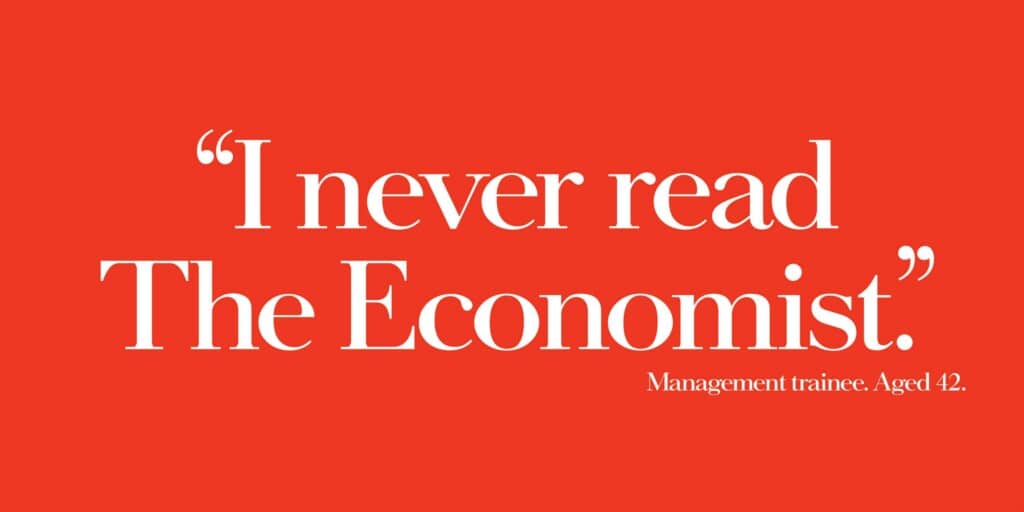
Roy Williams: That’s another way of saying loser. That’s another way of saying dumbass loser. And it’s like… And so here’s what they’re doing there. Now, see, that was… That’s a risky play.
Todd Liles: Risky.
Roy Williams: But let me tell you why. It’s not risky because it’s offensive. It’s risky because it’s over the head of average people. See, even if you’re brilliant, obviously The Economist paid for this. Remember about the hovering question mark?
Todd Liles: Yeah.
Roy Williams: So there’s this billboard, and obviously The Economist paid for it. Why would they say, “I never read The Economist”? It makes no sense. They’re trashing their own business. They’re quoting some testimonial of somebody who thinks they have no value. And then you read underneath in really small print, “Management Trainee, aged 42.” And you’re going, “Oh. Oh.” And then you conclude… They don’t make the statement. They do not make the statement that you make in your own mind. You know what it is? His boss reads it. It’s like the CEO of his company reads it, and they’re probably younger than 42. It’s kind of like winners read The Economist; wannabes, whiners, nose-pickers, crybabies, and idiots don’t. And it’s kind of like, huh, they didn’t say any of that. That’s just what the average person… When it goes click, and all of a sudden the mystery is solved. The people that don’t read The Economist don’t progress in life.
Todd Liles: Exactly.
Roy Williams: The people that do read The Economist climb the ladder, ring the bell, and sing among the stars.
Todd Liles: When I first found this ad, I didn’t know in what context it was placed. So I saw it and I’m going, “Oh, this is really interesting,” because my immediate thought was they’re putting this in a magazine somewhere, right? And the type of person that would read a magazine that would read The Economist, why would this work? So that’s why I went researching and said, “Oh, they’re not doing that.” They never placed it in a magazine. They always placed it in high foot traffic areas of where they knew people of substance would be. For the most part, someone that should be reading The Economist is going to be in this foot traffic area. I was just like, that’s pretty smart.
Roy Williams: Let me put it this way. It wasn’t targeting; it was mass media. I mean, they put it in train stations, they put it in subway cars, they put it in places where the same percentage of people that are going to walk down this sidewalk and see this sign on the side of a bus shelter. You know what I mean?
Todd Liles: They did put it on bus shelters.
Roy Williams: Of course they did. I’ve never seen this before. I was unfamiliar with this. The point is, I know how they would do this. And what they would do is show it to the whole world, and the fact that 79% or 83% of the people aren’t gonna get it doesn’t matter, because we’re looking for the people who do get it and go, “I should be reading The Economist. I get their point.” And that’s clever as hell. And these people have wit and they have restraint. It is such a restrained, it is such a subtle but freaking genius, unbelievably highly sophisticated slap. And all the people who were slapped don’t even know they were slapped. And the people go, “Oh, he’s still a trainee at 42. How sad.”
And so this is the perfect example… I’m so impressed, Todd. It’s the perfect example of the hovering question mark, this mystery that has to be solved. And I’m looking at it, and I’m glad you blew it up because I couldn’t see the tiny thing. It says, “I never read The Economist.” I’m not sure where that’s headed. But then when you blew it up, “Oh, Management Trainee, aged 42. This is great.”
Todd Liles: I thought you’d like that.
Roy Williams: Oh, that’s awesome.
Todd Liles: Well, Roy, on this topic of headlines, what is the one thing that you think the listener should take from today’s episode?
Roy Williams: Have the courage to be different, evocative, surprising, and occasionally absurd.
Todd Liles: I love it. Because, Roy, a headline isn’t there to say everything, is it?
Roy Williams: Nope.
Todd Liles: It’s there to start something: a conversation, a little bit of curiosity, a chain reaction that gets you to move to the next step. Do that well, you’ve already won half the battle.
Roy Williams: At least half.

We don’t just talk theory; we break it down so you can apply it. Join us as we reveal the secrets behind the most compelling ads ever created and help you wield the power of words to grow your business.
You can schedule a free call with Todd here.
- Why the Ads That Make You Feel Always Win (and Logic Rarely Does) - September 10, 2026
- Why Safe Brands Get Ignored and Bold Ones Win - August 26, 2026
- What Separates Ethical Persuasion From Manipulation - July 28, 2026