
The fastest way to waste your marketing money is to buy more leads before you know what happened to the ones you already had. If revenue is down, that does not always mean demand is down. It may mean the same number of opportunities are producing less money than they did last year.
For an HVAC owner, that difference matters. If the problem is demand, you need more good calls. If the problem is booking, dispatch, close rate, or job value, more leads may only make the leak bigger.
Start With What 100 HVAC Leads Are Worth Today
One useful way to look at the business is to ask what 100 good leads turn into today:
- How many get booked?
- How many get dispatched?
- How many become real technician opportunities?
- How much revenue comes out the other end?
Now compare that with last year. If 100 good leads used to create 70 booked calls and now create 61, you have found something worth looking at. The same is true if bookings are steady, but close rate or average ticket has slipped.
This gives you a better picture than revenue alone. Revenue tells you that something changed. It does not tell you where the change happened.
A Shift From Replacement to Repair Can Make Revenue Look Worse
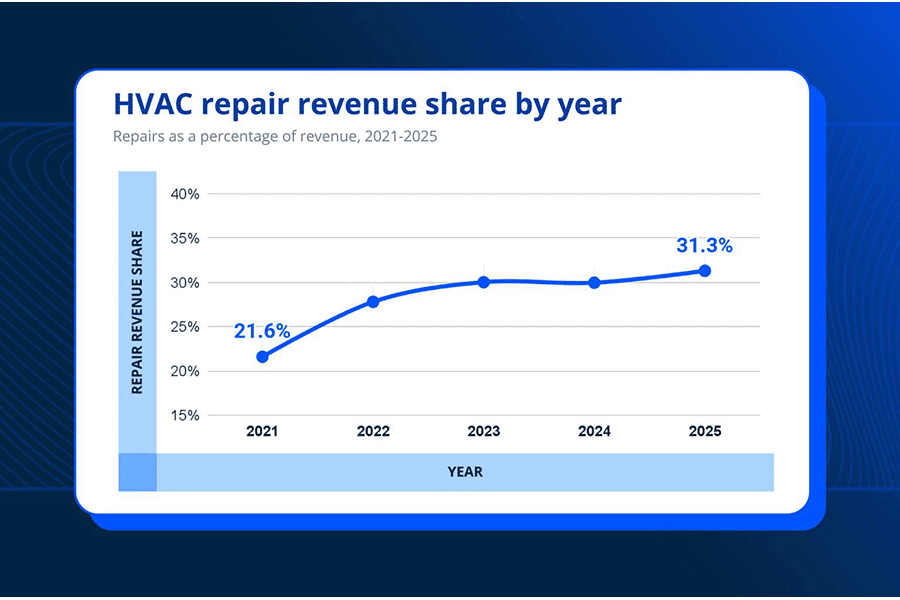
HVAC revenue can also change because the mix of work changes. Housecall Pro reported that repair revenue grew from 21.6% of HVAC revenue in 2021 to 31.3% in 2025. That means a business can see fewer replacement dollars while still getting a healthy amount of repair demand.
If you only compare total revenue, that shift can make the year look worse than the lead flow really is. A lower average ticket may reflect more repair than replacement than weak demand.
That does not make the revenue drop less important. It just changes the question from “How do we get more leads?” to “What kind of work are we getting, and what are we earning from it?”
Trace the Lead Until You Find Where Revenue Is Being Lost
Once you know lead volume is not the whole story, walk through the numbers in order. Look at booking, dispatch, technician opportunities, close rate, and revenue per job. You are trying to find the point where the business stopped getting the same result from the same amount of demand.
That point may be in the call center. It may be in scheduling, technician performance, pricing, or job mix. The key is to find the first change that meaningfully affects revenue, instead of reacting to whichever KPI looks worst on a report.
A five-point drop in one number may cost very little. A two-point drop somewhere else may be costing hundreds of thousands of dollars. The percentage size doesn’t match the problem size.
Only Buy More Leads After You Know Leads Are the Problem
There are plenty of times when the answer will still be yes. If good leads are down and the rest of the operation is holding up, marketing probably deserves more attention. But if good leads are steady, the better move may be to improve what happens after the phone rings.
That is easier to see when your numbers are connected instead of spread across separate ServiceTitan reports. Some shops successfully use DataTurk.ai to pull that path together, but the main point is simple: know what each stage is producing before you spend more to fill the top of the funnel.
More leads can grow an HVAC business. They can also hide a weak process for a while. Before you buy more demand, make sure the demand you already have is turning into the revenue it should. You would tell your clients to make sure their HVAC systems are optimized for performance; shouldn’t your lead flow be optimized as well?

DataTurk.ai helps home service business owners shift their focus from working in the business to working on it. In just a few minutes per month, they deliver valuable insights, guidance, motivation, and accountability to improve the business,
- Should You Buy More HVAC Leads? Not Before You Find The Revenue Leak - October 6, 2026
- Get To Know The Procrastinators - July 6, 2025
- You Can Quantify Trust - March 6, 2025