
In all my years running Google Ads, I have never broken a water heater.
Water heaters break without my help. One quits at 6:40 on a Tuesday morning. A woman stands in her wet garage, phone in hand, and types “water heater repair near me.”
That search is where Google Ads earns its money. It can’t make her need a plumber. It can put your name in front of her when she does.
Two British researchers, Les Binet and Peter Field, studied 996 advertising campaigns across 30 years and published the results in The Long and the Short of It. Their main finding fits on a truck door: advertising does two kinds of work on two clocks.
The slow kind is getting known and liked by people whose water heaters still work. Binet and Field call it brand building. The fast kind is catching the woman in the garage and turning her search into a booked job. They call it sales activation, and search ads are on their list of tools.
You need both. In the book’s data, campaigns that produce a large short-term response are about twice as likely as the rest to report large profit growth, even among campaigns that ran three years or more. So sales activation is worth doing well. It is the part I do for a living. Here is how to get your money’s worth from it, and where it stops.
The $49 tune-up
Your board is light next week. The fastest fix is a price cut. Fifty dollars off any repair. The $49 tune-up. The phone rings by Friday.
You know the two things profit comes from: how many jobs you book and what you charge for each. Sales activation moves the first number in weeks. What you can charge moves slowly. It grows as more customers pay your rate without collecting three other quotes. In the researchers’ data, that takes longer than three months to show, and it is still growing at three years.
A price cut works against that. It teaches people to shop you on price and to wait for the next offer.
A coupon fills this month’s schedule and lowers what you can charge next year.
When you need the phone to ring, give her a reason to call that isn’t a smaller number. A truck in the driveway by noon. A person who answers at 6:40.
Who is clicking?
The book sorts your market into three groups. Most people don’t need you yet. Some are already your customers. A few need someone today and have never called you. The woman in the garage is one of those few.
Those few are what Google Ads is for.
The temptation is your own customer list. Those people cost almost nothing to reach, and the report looks wonderful. By the researchers’ measure, campaigns that go after strangers work almost three times as well as campaigns that go after the customers you already have.
Google has its own version of your customer list: the people who type your company’s name. Agencies call that branded search. Those people were already coming to you. Brand building sent them. Count their clicks as a win for the ad, and any account looks good, mine included.
Ask whoever runs your ads one question: “How much of my spend, and how much of my revenue, comes from people who searched my name?” On average across my accounts, a dollar spent on name searches brings back $45.90. A dollar spent on strangers brings back $3.60. Blend the two, and the $3.60 hides behind the $45.90.
Companies grow by adding customers, and small companies especially so, because they start with fewer. Spend your Google money on the stranger.
Two clocks
How long do you wait before you judge a Google Ads campaign?
At least 21 days. A campaign won’t show solid performance before then, and it can take up to three months to get there. That is my experience in the accounts, not a number from the book.
Three months is still the fast clock. The researchers say to judge sales activation over the short term, and they add a warning: activation that doesn’t work early will probably never work.
Brand building runs on the slow clock. The book gives it at least six months, and better a year. Judge everything inside six months, and the numbers will favor sales activation, because it is the faster of the two.
The two clocks also need two yardsticks. Sales activation shows up in numbers you can count this month: bookings, revenue, and return on ad spend. Brand building shows up in slower numbers: your share of the market, and how well your price holds when a customer could shop around. Measure brand building by this month’s revenue, and it will look bad, even when it is working.
Why not all Google Ads?
If Google Ads brings the bookings, why not put the whole budget there?
Because it can only collect the people who need someone today. It leaves nothing behind for the neighbor whose water heater has two good years left.
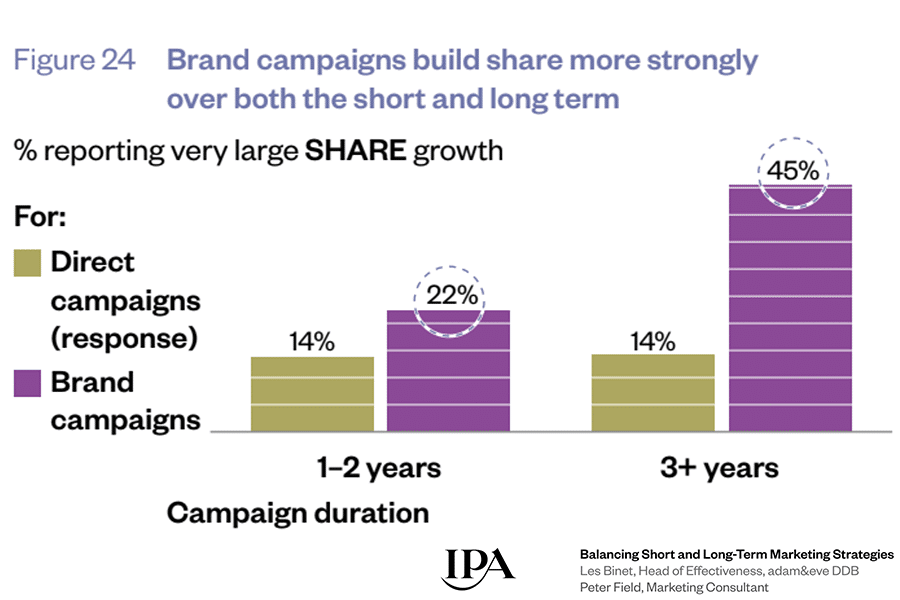
Three years in, 14% of sales activation campaigns report large gains in market share. For brand-building campaigns, the figure is 45%.
The two also help each other. Run both, and the same budget grows your market share twice as fast as it does with brand-building alone. The best results come from campaigns where one idea does both. They sell almost as hard as sales activation campaigns today, and they earn more profit. I read that as one voice: the ad she finds at 6:40 should sound like the company she has heard about for years.
The budget that performs best in the data puts about 60% on brand building and 40% on sales activation. The researchers call that finding tentative. What I can tell you is the average across the accounts I manage. A booking from a stranger’s search costs 13 times as much as a booking from someone who typed the company’s name. When people already know the name, Google costs less.
I still can’t break a water heater. I can make sure she sees you at 6:40, with a reason to call that isn’t a coupon.
Brand building is yours. Do it well, and one morning she skips “near me” and types your name.
The phone rings.

In the wrong hands, Google Ads can become a dangerous and addictive drug.
We transform your Google Ads addiction into your Business Super Supplement. We
help make sure your brand’s personality is reflected in your Google Ads. Plus, we
continually refine your PPC campaigns for both efficiency and growth.
- The Short of It - November 19, 2026
- How Big Do You Really Want to Be? - October 30, 2026
- The Two Things He Refused to Cut - October 14, 2026