

Many business owners think pricing decisions occur during the estimate, the proposal, or the sales conversation, but we can assure you that they don’t.
When a customer asks what something costs, they’ve already created in their minds a general idea about whether your rate will be “reasonable,” “expensive,” or “not worth it.” Oddly enough, that opinion usually has very little to do with your actual numbers.
Customers make that decision earlier—when you’re not in the room—and it’s the reason that so many pricing conversations feel uphill.
The Conversation On Price Before The Phone Rings
Ever raised your prices and felt nervous about it? You’re definitely not alone. It’s easy for a business owner to assume price resistance is the logical result of things like a tight market, competitors offering what you do for less, or customers who are overly cost-conscious. And it’s true, sometimes, but frequently it isn’t.
In truth, the customer probably just doesn’t trust you yet. It’s not so complicated. And if the customer doesn’t trust you, the only way they can evaluate you is on price.
We frequently hear of situations where two companies offer basically the same product/service but one is questioned and negotiated with to a point of frustration — while the other is accepted with very little pushback. It’s the same market and the same economy, but the two outcomes are very different.
It’s just a matter of trust.
Trust Is A Filter
Trust makes closing easier, and it changes who calls you in the first place. For example, we have a home-service client in Virginia who told us how frustrated they were that every call they had felt transactional; they said customers would call and want quotes immediately, with no attempt to build some kind of context or feeling. These conversations would then end with the potential customer offering no commitment at all and saying they’d check with a few other companies.
The problem here was that their brand wasn’t doing any filtering for them. So, over time, we helped them clarify and consistently communicate who they were and how they approached the work. This is the key to moving up.
Sure enough, only a few months in, something changed.
They were still getting calls, but the tone was different—and had shifted away from price-first conversations. Our client had more callers saying things like, “You came highly recommended,” or “I’ve been hearing your name for a while.”
They didn’t have to lower their prices to get less resistance because trust improved the quality of demand.
Trust Discount, Meet Trust Premium
Low-trust businesses pay a kind of tax for being low-trust. They discount a lot, they have to explain themselves more often, they have to justify pricing, and they have to chase decisions from their clients.
High-trust businesses earn a premium for being high-trust, even if they don’t think of it like that. Customers accept their prices with fewer issues, they ask fewer questions in general, they’re less likely to shop around, and they stay longer.
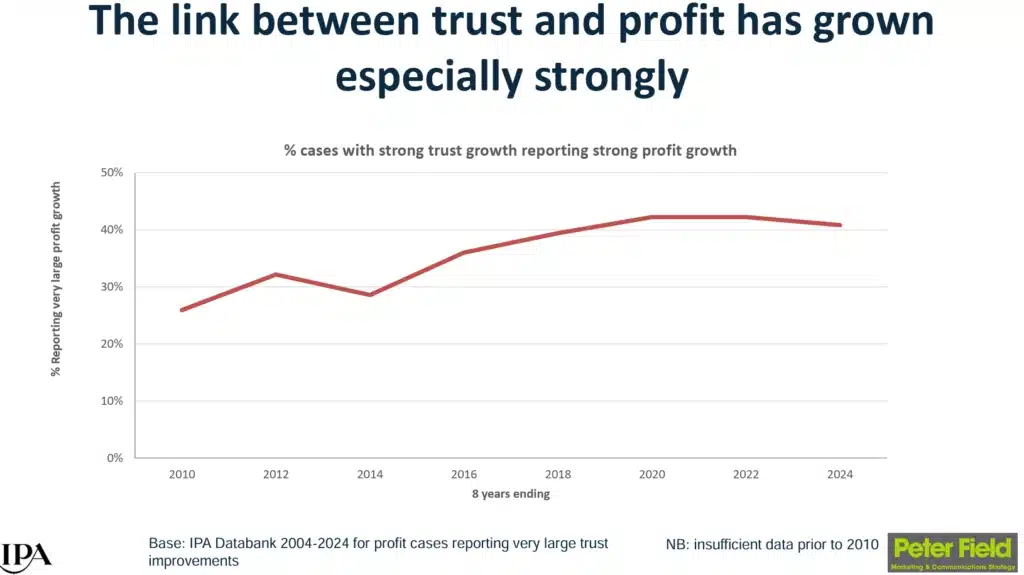
Another client of ours didn’t raise prices at all, but instead invested in long-term visibility and consistency. They stuck to the same message and tone, and repeated it over time. The result was that revenue went up because they didn’t have to discount as much. The trust premium gradually replaced the trust tax.
In our experience, that’s how it tends to work.
Tactics Don’t Fix Bad Trust
Business owners get frustrated and try all kinds of things. Better offers, rewritten scripts, more follow-up, harder training, and so on. These things do help, but somewhat at the margins. They don’t really change the underlying dynamic.
It’s important to remember that if customers don’t really trust you, tactics to catch their business will feel like pressure to them. And if trust is high, tactics aren’t necessary.
We’ve seen businesses pour money into lead generation while ignoring trust signals, only to attract more price-sensitive customers and more stressful conversations. They got more volume but had the same margin problems.
That’s a trust issue, and trust is built before a sale.
How To Build Trust
You build trust with consistency.
When the market sees the same business telling the same true story, over and over again, you build trust. When your presence feels familiar, you build trust. When people know what you stand for without needing to look it up, you build trust.
Building trust like this is how businesses stop being “one of the options” and start being the one people thought of. Pricing conversations get shorter, sales cycles tighten, and business owners experience less friction for better work.
That’s the compounding effect of trust.
What Business Owners Can Do With This
In the end, this isn’t about branding, or even polishing language. It’s really about deciding who you are and then being that consistently enough that the market starts to believe it.
Practically, that looks like:
- Communicating a clear identity instead of a list of features
- Being visible even when you don’t need immediate leads
- Repeating the same message long enough for it to stick
- Letting trust filter your customers before the phone rings
Once you’ve taken care of these things, customers stop doubting your value, and you can breathe easier with your pricing.
Closing Thought
You can’t argue your way into having power over your price. The market will slowly give it to you over time, based on trust. Customers who push back on price aren’t necessarily doing it because you’re too expensive; it might just mean you weren’t present early enough to shape their decision.
The good news is that you can deliberately build trust as an asset. And, once you’ve built it, price stops being one of those things you have to fight to win every time.
I specialize in building trust for my clients with consumers, if we should talk, you can email me at MattWillis@WizardOfAds.com.

- How Do We Build a Customer Loyalty Engine? - March 17, 2026
- What Is Your True Competitive Advantage - March 9, 2026
- Why Marketing Feels Less Predictable Now - February 27, 2026