
Dear Reader,
There’s a fine line every leader walks… and most don’t realize they’re walking it.
On one side is persuasion, the honest attempt to share what you believe.
On the other is manipulation, the attempt to control what someone else believes.
From the outside, they can look almost identical.
But on the inside (in the place where intent lives) they couldn’t be more different.
This episode is about that line.
Roy H. Williams and I explore the psychology of how people decide what’s true, why confidence transfers from one mind to another, and why sincerity outperforms technique every time.
We talk about illusions not as tricks, but as windows into human perception — how the brain fills gaps, chooses meaning, and builds its own version of reality.
And we explore the responsibility that comes with influence.
Because great communication isn’t about control.
It’s about clarity.
It’s about honesty.
It’s about helping someone see more clearly than they did before.If you’ve ever worried about “selling too hard,” or questioned whether persuasion can be ethical, this conversation will challenge you — in the best way.
Influence isn’t dangerous when your intent is clean.
In fact, that’s when it becomes a service.

Watch/listen above or read below.
Todd Liles: Today we’re taking on a word that makes a lot of people squirm. Manipulation. Because people assume that advertising manipulates folks into buying things that they don’t need. It’s the reason why so many business owners say, “I don’t want to be salesy.” But you and I know that the real power of advertising doesn’t come from pressure or trickery, it comes from trust and imagination.
So today, Roy and I will be separating the myth from the truth, what manipulation really is, what persuasion really means, and how ethical advertising helps people make better choices freely. And today what we’re going to talk about, Roy, is we’re going to talk about what I believe to be a myth. It’s one of the topics that we’ve hinted at before, but it’s the concept that advertisement is manipulation. And I don’t believe advertisement is manipulation.
Roy Williams: Wait a minute.
Todd Liles: Oh, okay, come on.
Roy Williams: So here’s the deal. We can’t have this conversation until we define the word manipulation.
Todd Liles: Let’s do it then.
Roy Williams: Okay, listen. Persuasion is manipulation.
Todd Liles: Okay.
Roy Williams: Any persuasion. Anytime you’re having an authentic, genuine discussion about anything, and I’m trying to make you see my perspective and you’re trying to make me see your perspective, how is that not manipulation?
Todd Liles: Yeah, so it’s…
Roy Williams: So, see, we have to draw a line. We have to define manipulation as being something malicious or underhanded or sneaky or tricky or unfair or just dirty. And I’m going, but you know what? If a person is a believer in something and they believe it with all their heart and they try to convince you to believe it, too, the fact that you don’t believe it might be annoying to you, but is this person attempting to manipulate you?
Todd Liles: Yeah.
Roy Williams: Are they manipulating you? No. They’re trying to share something with you that they believe in completely and authentically. And I’m going, so we have to decide. Because, see, when you start talking about persuasion, when you start talking about transferring your confidence to another person, that’s all selling is. Selling is the transference of confidence.
There’s only one reason anybody ever says no. There’s only one reason anybody ever says, “Let me think about it.” They don’t have confidence that today is the right day, that yours is the right company, that you’re the right salesman, that this is the right price, or now’s the right time.
But when they have confidence that today is the right day, yours is the right company, you’re the right salesman, that’s the right price, and today’s the right day, they say yes. And I’m going, okay. So when they don’t have confidence, they say, “Let me think about it.” When they do have confidence, they say yes. They have to get their confidence from you, the salesperson.
Todd Liles: Right.
Roy Williams: You have to give them your confidence. Now, wait a minute. This is important. If you don’t actually believe what you’re saying, you can’t transfer confidence, you can just lie to me and try to manipulate me.
Todd Liles: Right.
Roy Williams: And so if you don’t believe in it, for the love of God, don’t try to sell it. Get a different job. But I’m saying if you really honestly believe what you’re saying, you’re not capable of being manipulative. All you’re doing is trying to communicate something that you think is true to somebody else. And if the techniques that you’re using could be misused by somebody that was dishonest, then they’re being manipulative, it’s not the technique that is manipulative. Does that make sense?
Todd Liles: Yeah, yeah. It absolutely makes sense. The thing that’s interesting is there’s probably some sort of visual that I’m going to create here, but I wrote down reason and I wrote down confidence. Maybe there’s another overlapping thing, but we’ll put that with reason. But what goes on in my mind when you talk about this is a couple things. One is that if I came at you and I had confidence and I had the right reason, so… And it was a good reason, it was a just reason.
Roy Williams: Right.
Todd Liles: Most of the time we’d say, okay, it’s a just reason, so therefore he’s actually trying to be persuasive. And he’s got confidence. But one of the things that you said in the beginning that made me go, “Oh, that’s an interesting perspective.” What if I’m coming with you for all the right reasons and with all the great confidence, but I’m sharing a message with you that is really just totally counter to your belief system? No matter if I were trying to be persuasive or not, because this is one of those reality scenarios, you might only take it as being manipulative.
So when you go, “Hey, let’s define it,” the part of the definition that I like, that I think that you added that I’ve not considered, and I’m going to say it like this, is that if we’re just asking the question from Todd’s perspective, what is he attempting to do? The answer is he’s attempting to be persuasive. He has a very good reason to communicate something he believes confidently in. That’s his purpose. We could also say that’s because it’s attached to goodwill.
If Todd came at this and it wasn’t attached to goodwill, his reasons were only self-serving, then we would automatically go, “That person’s trying to be manipulative.” Now, what’s interesting is we can say, “What is the person trying to be?” and then we can also ask the same questions of how’s it being received? What is the receiver of the information? How are they receiving it? And I do think that it can start as manipulation and switch to persuasion.
Roy Williams: I’m with you. I’m with you. I’m with you. But here’s the thing.
Todd Liles: Yeah.
Roy Williams: It is utterly subjective. A technique. Could you create a technique that was overtly and always manipulative? Yes.
Todd Liles: I think so.
Roy Williams: And I’ll tell you what it usually is. It’s all the little canned things where they say, “Well, when the customer says this, this is what you say. When the customer says this, it’s your comeback.” And I’m going, okay, so wait a minute. They’re trying to teach you what to say and you don’t have to believe it. It doesn’t need to even be any truth in it because your trainer, your coach, your sales manager just taught you how to be a parrot. And so you’re just the echo of your sales trainer if you’re going out there and repeating what you were told to say.
Todd Liles: Agreed.
Roy Williams: And so I’m going, so yeah, that’s just where two morons met and one taught the other one to be an idiot. And so I’m wildly against that. I detest insincerity, and I don’t give a rat’s butt how much money you can make by being insincere. I just think it’s always a bad idea. It’s not a good way to live your life.
Todd Liles: I agree with you. I want to read this really, really fascinating quote. It’s a concept of two realities, and it says the following. “Advertising cannot change objective four-dimensional reality. But it can powerfully change perceptual three-dimensional reality.” What does that mean?
Roy Williams: Okay. We live in four dimensions: height, width, depth, and time. In Physics 101, you learn about the first four dimensions. Height and width create two-dimensional space. You add depth, so a square becomes a cube when you add depth, and that’s space. And then the fourth dimension is time. And so the space-time continuum is what we call reality. Okay?
And so in reality, in four-dimensional objective reality, that’s wood. And your opinion doesn’t keep it from being wood, doesn’t change it from being wood. I don’t care how much you believe it’s not wood. It’s wood. It can be demonstrated to be wood. This is wood, and it’s not subject to your opinion about whether or not it’s wood. But you live most of your life, Todd, alone in a private reality that is the mind of Todd Liles.
Todd Liles: Yeah.
Roy Williams: Now what happens is, does it have height, width, and depth? Yes. The visuospatial sketchpad of working memory is the mind’s eye. And you can imagine things. You can see things. You can experience things in your mind. And you do it when you watch movies. You do it when you watch TV. None of that’s real. You know it’s fiction when you’re watching the movie. You know it’s a made-up story and those are actors and it’s a mechanical shark and there’s no real danger here.
But yet half of your brain doesn’t know fact from fiction, true from false, right from wrong, or it doesn’t care. That’s the left brain’s job. So the right hemisphere of your brain is reacting with genuine terror. But the thing that’s happening isn’t happening in reality. It’s happening in perceptual reality, which is outside the space-time continuum. It’s only the private little world of your mind. And so your opinions, your beliefs, your passions, your creativity, your loyalty are all expressions of you. And none of those exist in the space-time continuum. They only exist in this private world called the mind of Todd Liles.
And so most of us live alone. And communication, this is where it’s weird. So we can only communicate in the overlap between the reality that I live in and the reality that you live in. Now, we both live in four-dimensional objective reality, but our beliefs, our perceptions, whether or not it’s a good day, whether or not it’s hot or whether or not it’s cold. I’m sitting here bundled up, and you’re sitting there radiating heat out of your skin.
Todd Liles: I’m literally hot right now.
Roy Williams: I know this. And so what I’m saying is, because of things we don’t need to talk about today, I’m actually very cold. And I need all this. It’s not a fashion statement. And so whether or not it’s hot or cold is literally determined by the response, as you were saying earlier, the response of the person. No, it’s cold to me, and it’s hot to you, and it’s the same temperature in the room. So in my perceptual reality… Perceptual reality is utterly subjective and it is up to… So, what’s your favorite food?
Todd Liles: My favorite food is probably… It’s probably… The reason why I’m struggling with this, Roy, is I have so many foods that I love.
Roy Williams: Well, just pick one.
Todd Liles: So I’m gonna go steak.
Roy Williams: Steak. No. Steak is not good. Steak is not your favorite food. Wait a minute.
Todd Liles: But it is, Roy.
Roy Williams: Well, what I’m saying is it’s like I sound like an idiot because I’m speaking to the god of Todd Liles’ world. Todd Liles, may he live forever. I’m speaking to the master of Todd World, and I’m trying to tell him about something in Todd World that I’ve never lived in. I’ve never even visited Todd World. And so communication can only happen. But here’s what happens. When a person responds to a subjective reality as though that can be wrong, no. The man can like steak. It’s not up to you whether or not he likes steak. He can like it and you can dislike it, and that doesn’t change the fact that it is steak, right? And so that’s the difference between perceptual reality and objective reality.
Todd Liles: I want to tell you something that I find interesting about what you said about the statement of time. Because Shannon and I went on a walk yesterday, just me and her. It’s like, “Hey, let’s go for a walk.” So it’s probably 5:00 o’clock. It’s the time of year where the sun’s going down a little bit earlier, but we’ve still got another hour of daylight. And as often when I’m just hanging out and visiting Shannon, I just feel that love for her, right? And I’m telling her, it’s like, “Hey, I love you so much.”
And then we started talking about how long different animals live. And I turned to her and I said, “Hey, let me ask you a question because I’m sitting here thinking about this. If we had these amazingly long lives, let’s say our life on average was 5,000 years and we knew it was 5,000 years.” Because we’re past the age, really, of having babies, and it’s like, I’d love to have another kid, but probably not at that age.
But I said, “Do you think that I would love you as much as I love you now today if we knew that we had another 5,000 years in front of us?” And she goes, “Heck no.” She immediately said, “No.” She said, “We’d be bored with each other, and if it was 5,000 years from now, we might have been married 100 different times.” And I said, “I don’t know.” She goes, “No, I think you’re being really romantic and whatnot.” But I’m like, I’m not sure. I said, “I think there would be couples that would still make it to 5,000 years, and some wouldn’t. Most would probably do what you said.” She goes, “I think it’s the fact that we know this is going to end that makes it so sweet.”
So she layered in her dimensional time, and I’m here going, “I’d love you forever.” She’s like, “Nah, I’d be done. I’d have a couple hundred down the line.”
Roy Williams: Oh, gee.
Todd Liles: Yeah, I don’t think she means it.
Roy Williams: No.
Todd Liles: But I have one other thing that I was thinking about. We went to Disney a couple weeks back. I think I told you that. And we rode this ride. It’s a brand-new ride. It’s a Guardians of the Galaxy ride, which is based off the movie. So it’s really neat, right? And the thing that’s different about this roller coaster is that, first of all, they send you in backwards. But the roller coaster is on a track, which is not new, but it’s also mechanically tilting. So it will point you in the direction it wants you to look. And when you’re on it… And it’s completely dark except for these screens. You’re not sure how they’re, you don’t know if they’re projectors or what they are. I’ll tell you what it is.
But it’s making you see what it wants you to see the whole time. And then at another point, it’ll flip around and you look like, you feel like you’re circling the moon. And it’s amazing. It’s absolutely thrilling. You don’t know how fast you’re going, but you’re absolutely convinced you’re going a million miles an hour. Well, my sister went back after Shannon and I left. She wanted to ride it one more time, and it broke down. And all the lights came on, and she was telling me how it looked. So I went and I looked it up.
And there are videos where people, same thing happened to them, and they ride the ride from beginning to end, and every light’s turned on. So what is normally in the dark except for a few movie screens, you see everything. You see the track, you can see the screens, but the lights of the ride are way overpowering compared to the LED projectors. And when you watch it, as you go through, you go, “You know what? Disney is a master at,” whatever word you want to use, persuasion or manipulation. They’re an absolute master because when you’re on this ride and they’re having you look at just what they want you to see, when they’re pointing you and they’re moving you, you think this ride is going 100 miles an hour. You think it’s absolutely amazing.
And when all the lights are up and you can do like this and you can see all the things that are happening around you, you realize that if they weren’t pointing you visually to where you needed to see, you would have a horrible experience. If they turned up the lights, you’d be bored to death. You’d realize you’re only going about 20 miles an hour. It’s no fun.
Roy Williams: Let me offer you a word. When you were saying you didn’t know what to call what Disney was doing, let’s call it illusion.
Todd Liles: It’s illusion. It’s absolutely illusion.
Roy Williams: It’s illusion. Now, here’s the thing. When I say the word illusion, at least half the people think, “Oh, yeah, that’s trickery. That’s fake.” Nope. Nope, nope, nope. Anytime you look at something and you see beauty, that’s an illusion. It’s neither beautiful nor is it ugly. Your reaction to it is what causes you to say beauty. It triggers something in you that is pleasing and lofty and it is wonderful, and you say, “That’s beautiful.” And you mean it. But the thing itself doesn’t possess beauty. It feels, seems, tastes, smells, and acts beautiful in your mind, but maybe not in somebody else’s mind.
And so whenever you tell a story, you’re projecting an illusion. The thing you’re telling a story about is imaginary or it’s in the past, and the past is gone. And so if you’re going back into the past and telling a story and you weren’t there and they weren’t there, is the story still true? And what they’re seeing in their mind and what you’re seeing in your mind, both of you are seeing an illusion.
Now, can the illusion basically be the truth and that is what happened? Yeah. Even though neither one of you saw it, neither one of you was even alive at the time, is it a true story? Yes. But are they seeing the reality of it? No. What they’re seeing in their mind is an illusion. And so persuasion is about illusions and communication… I’m gonna do it. I’m gonna do it right now. You ready?
Todd Liles: I’m ready.
Roy Williams: Okay. Now, before I get started, I’m gonna read you the Monday Morning Memo for November 17th, 2025.
Todd Liles: Great.
Roy Williams: It’s not a long one.
Todd Liles: I look forward to it.
Roy Williams: And it’s controversial.
Todd Liles: Uh-oh.
Roy Williams: And it’s gonna be a little bit troubling.
Todd Liles: You’re hearing it here first, folks.
Roy Williams: It’s gonna be troubling. It’s gonna be troubling. Okay. Now, I’ll summarize it by saying this. Long after they have forgotten your bullet points, they will remember the stories you told.
Todd Liles: Absolutely.
Roy Williams: Passions, scars, and wounds.
It is easy to understand a person who is driven by their passions.
Your passions take you to your happy place.
I have friends who have a passion for sporting events on television. Others have a passion for gambling, and the paripatetic have a passion for traveling to all the far-flung places on this spinning rock we live upon.
People who have a passion for achievement live to make things different.
Planning and research puts a candle to the wick of some people. They go without sleep and burn bright throughout the night as they gather, collate, and organize information that will set the future on fire.
Your scars are the memories of bitter experiences.
The pain is gone, but the benefits of those experiences remain. Your scars help you see danger on the horizon.
Your scars are the diplomas of lessons you will never forget.
It is good to have scars.
But wounds… wounds are different.
The pain remains and it triggers you to act in ways that everyone notices but no one understands. Sometimes not even you.
I have known men whose only passion was to seduce every woman they encountered. Those men like to believe that they are “in love with falling in love.” But when you have known them long enough you will see a knife wound in their chest that has never healed. Way back in the long ago, they had a wife who began sleeping with another man. And ever since that day, they have been trying to become that man.
The pain of a wound is a powerful thing. It shouts, “Never again! Never again! Never again!”
I don’t believe that any of those men have ever figured out why they feel driven to become the living embodiment of the imaginary Don Juan, and I have never felt that it was my place to tell them.
Every person is formed by their passions, scars, and wounds. Even imaginary people.
All of the famous characters in literature were created from their passions, scars, and wounds.
Novelists, playwrights, and screenwriters know this. Ad writers do not. This is why most advertising is dull, dead, and untwitching.
When an ad writer is guided by the ambitions, demands, and expectations of their clients, you can expect to hear the glorious trumpets of a ringing call to action. “Come! Come now! Give me your money! Hurry! Hurry! I want your money Today! Today! Today! Act now! Don’t delay!”
We are not enchanted by these ads.
Did it ever occur to you that every successful brand is a character that lives in the mind of the customer?
A successful brand is driven by its passions, scars, and wounds.
Passion: Why does this brand exist? What is it chasing? What love does it represent?
Scars: What does it know? What has it learned? Why can I trust this brand?
Wounds: What is this brand trying to erase from the earth?
To what does it shout, “Never again! Never again! Never again!”
Todd Liles: Roy, that’s very good. You are a poet. I think you know this. And what you said specifically about the wound where everybody that’s trying to be a seducer of as many women as they possibly can, and then you hit it right dead in the center, they probably had someone that wounded them very deeply. It’s a dramatic truth to that.
Roy Williams: Now, here’s the thing that a lot of people are asking themselves right at this moment.
Todd Liles: What’s offensive about it?
Roy Williams: No. They’re gonna say, “Well, I don’t believe that about a brand, that it has to be trying to eliminate something from the world or that it’s got something it’s trying to erase or stop or fight against.” No, you’re wrong. Most brands aren’t aware of the thing that they really stand against. But if you are not trying to make something disappear, if you’re not trying to make something go away, if you’re not fighting against something, then your product or your service has no purpose. Because the purpose is to change something and increase someone’s happiness. Do you know why yoga pants exist?
Todd Liles: Yes, because blue jeans are too tight after a big Thanksgiving dinner.
Roy Williams: Nope.
Todd Liles: My attempt at funny. Actually, I don’t know why they exist.
Roy Williams: No, it’s real simple. Now, see, you can say, “Well, yoga, there’s yoga pants. It’s for yoga class.” Yeah, yeah, yeah, yeah. That’s what we all tell ourselves, and that’s what the brand believes, and it’s all about yoga, and it’s all about working out, and blah, blah, blah, blah. No, why did they become so popular? Why did it become a big, multi, multi, multi-billion-dollar industry? You know what they’re fighting against? Cottage cheese thighs and flabby asses. Bottom line. And if you are trying to get rid of cottage cheese thighs and flabby asses, you put on yoga pants and you look tight, taut, and firm, right? And fit.
Todd Liles: They lift and separate.
Roy Williams: No, listen, the bottom line is… I’m totally serious. I’m deadly serious. And I’m going, when you write ads, you have to go, “Okay, what is actually happening here?” What are people… They don’t want to admit it to themselves. The brand’s certainly not gonna put it that way ’cause it’s crass. But the real truth is, you like the way you look in the yoga pants, girls. I’m sorry. We like the way you look in the yoga pants also. Let’s all be honest. But my point is, until the ad writer actually understands the transaction that’s happening, the one that no one talks about, no one admits, and maybe no one’s even aware of, now you can speak to that without speaking quite as directly as I just did. Does that make sense?
Todd Liles: Yeah.
Roy Williams: And I’m saying until you know what this brand actually… Why does this brand exist? What’s it chasing? What does it believe? What love does it represent? It’s chasing some kind of an identity, some kind of a purpose, some kind of an adventure. And so what does this brand stand for? And if you relate to that idea, then you’re attracted to that brand. It believes in something that you believe in.
Now, scars. What has this brand been through? What has it learned? And so all of the old brands that have been around for a long time that have modified, modified, modified, modified, they’ve learned things. “Oh, if you do it this way, it works better than that way,” and you want the pocket here or whatever. And it’s like what we were talking just before we got started, what you have figured out about podcasting since you got started just a few months ago, and you’re getting so much better at it. We knew you would. And it’s like nobody can tell you what to do.
Todd Liles: You have to figure it out.
Roy Williams: You have to figure it out. You have to realize, “Oh, I have found out a better way. I have found out, oh, I prefer this. This works better for me.” And so every company that is on always continual self-improvement, you know what they’re doing? They’re learning.
Todd Liles: Okay.
Roy Williams: I just ask people to go slow on the word “manipulation” because until you define, until two people agree on what that word means to them, then it’s a really… It’s a weird word. It’s a loaded word. And you can argue forever and finally realize that both of you are pretty much saying the same thing. You just have this one word that you have two different definitions for. And so manipulation is one of those words you have to be careful of, and it means nothing until you clearly define it for the purposes of this conversation.
Now, here’s another thing, though, that Dewey Jenkins taught me, and I’ve never forgotten it, because you were talking about you don’t change… One of the first things you said that you and Alan talked about was you don’t change culture with policies. Okay? And what’s interesting that Dewey told me one day, because he has this astounding, just crazy good company culture. Nobody ever leaves that company. It’s always voted best company to work for in Charlotte. I mean, it really is just an incredibly well-run company.
And he said, “Roy, collisions only happen at intersections.” And he said, “When you get two people and they’re wanting you to make a policy and they’re wanting you to decide who’s right and who’s wrong and we gotta have a strict policy here,” he goes, “No. What we have here is an intersection of two people. And you both, it’s where what you’re doing with all your heart and what this other person is doing with all their heart, you collide.” And he said there’s certain intersections to where two different people will collide.
And he said, “So what we taught them is, ‘No, don’t bring that here. You sit down and you say, “Okay, let me tell you what I need,” and then you tell me what you need.’ And then you listen to what this person needs and you tell them, ‘Well, here’s what I need.’ And then they go, ‘Okay, well, how can we figure this out?'” And they said, and they will figure out, “Okay, here’s how we’ll handle this.” And once they’ve communicated, he said they can always figure out a way to show courtesy to the other one and get that same courtesy shown in return, and we make sure that each one gets what they both need.
And he says, “The only time you get to come here,” and it should be horribly embarrassing when they come into this office and they say, “We can’t work this out between us.” He said, “That’s not good. That’s an absolute failure because if you wanted to, you could definitely work it out. You could definitely figure out how to avoid that collision.”
Todd Liles: Right.
Roy Williams: And so what happens is that idea of not only empowering the people but changing their perspective and making sure they understand, “No, it is your responsibility to sit down and stay calm instead of getting mad and running and telling the boss,” and wanting a ruling, wanting a judgment on this and create a new policy, and…
Nope. Collisions happen at intersections and we have to have rules of the road, but y’all need to decide what the rules of the road are.
Todd Liles: Right.
Roy Williams: And then when y’all figured it out, let us know. And he did that very, very, very successfully. And people learned. They started acting like grown-ups. They started acting like friends. And I’m going, “I’ve never seen anything like it.” And there’s not a lot of policies. There’s not a lot of policies in that company. And I just sit back and I’m going, “Man, I wish I’d have met him sooner.” You know what I mean?
Todd Liles: I love that. And we will often tell people that they absolutely need to have core systems and procedures in their business. But when they say… Some people get obsessed with it. They think they need a system and procedure on how to write an email. It’s like, no, if you gotta have a system and procedure on how to write an email, then you’ve got some other issues. This actually isn’t a culture, right? Systems and procedures are repeatable processes that someone else needs to pick up and carry down, but the real operating system of a business is their culture. And I think you’re picking up on that.
Before we go in the ad segment, I’m gonna circle back to what you were talking about when you were talking about objective truth and subjective truth. And I just want to share a thought with you that I’ve often thought, and I think it’s amazingly beautiful and gorgeous. Objectively, there is this four-dimensional universe that is real. There are galaxies and stars above us. There’s the Earth below our feet. We live in this beautiful plane. And last night, many people got to see the Northern Lights in Texas, which is sort of rare, right? And we go, “Wow, that’s beautiful. That’s beautiful.”
Objectively, it just is a thing. And if you are a person of faith, then you believe God brought humanity here, and humans have this ability to do something that the rest of the universe at large doesn’t have to do. And I’m not talking about breathing and eating and living, because many animals do that. Humans have the ability to hold things into subjective value. They can see something and say, “That’s beautiful.” So if you have a faith base, that’s awesome. I think what may be even more beautiful is if you actually don’t have a faith base, and yet humans are here, which means you believe that we are pure substance of the universe. And what I like to think for those people that are atheists or whatnot, I want to just give you this. Isn’t this beautiful? The universe created humanity so it could be aware of itself. And I think that’s beautiful also.
Roy Williams: That is a beautiful thing. You don’t know this. As a matter of fact, nobody knows this. On December 22nd, I’m releasing a 75-minute audiobook, and it’s The History of the World According to Roy. And it’s a campfire story told by a bunch of old men. And the way that every culture for generations, the tribal elders would chant the song and they would all tell the stories of how all these things happened. And it is… There’s about a half a dozen people that have heard it, and I said, “Yeah, this is gonna be a Christmas story that I release on December 22nd.” And there’s a little script you can read along with it if you want to, but it’s all performed amazingly musically. It’s just this one long story, and what you were kind of talking about is actually what it’s kind of about.
Todd Liles: That’s awesome.
Roy Williams: Yeah.
Todd Liles: That’s cool.
Roy Williams: It’s like one of those moments where you’re describing what I just actually produced. It’s finished.
Todd Liles: I love it. We are so often on the same page even when we don’t talk.
Roy Williams: Yeah. It’s really weird. It’s really weird.
Todd Liles: It’s really weird.
Roy Williams: I’m listening to that and I’m going, “Oh, it’s always like that.” I didn’t tell him anything about it. He hadn’t seen it. He hadn’t heard it yet. I’ll play some of it for you later.
Todd Liles: That’d be great.
Roy Williams: All right.
Todd Liles: All right, Roy, let me show you an ad. And for the listener, if you go over to our website, toddliles.com, and search for the Wizard of Ads, you’re gonna be able to see this one because what we have here is we have the original ad from Doyle and Dane and Bernbach in 1962. And it is a print ad. And, Roy, I even have the radio ad over here. Alex, make that as big as you can, if you don’t mind bolding the print. I’m going to read the print ad. And, Roy, you’ve got that beautiful radio voice. I’m going to ask if you will read the original radio ad. This is the original ad from 1962 that went with it. But in the print ad, they have a beautiful young woman with like a slightly longer-than-bob haircut. She’s smiling, the wind’s slightly blowing her hair, and this is what it says. It says, “Avis can’t afford not to be nice, or not give you a new car like a lively super-torque Ford, or not know a pastrami on rye place in Duluth. Why? When you’re not the biggest in rent-a-cars, you have to try harder. We do. We’re only number two.” Now, Roy, can you see that, or do we need to make it a little bit larger?
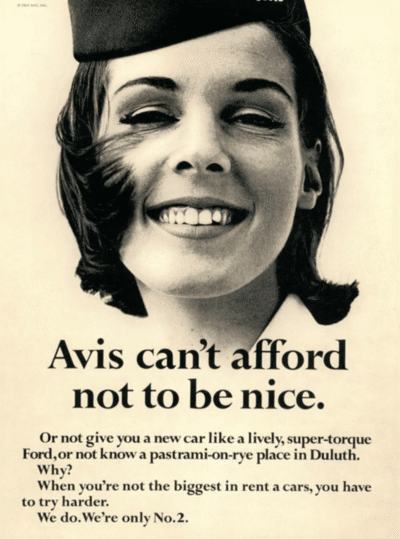
Roy Williams: I think I can probably read it. We’ll talk about this. I was alive in 1962. “Avis is only number two in rent-a-cars, so why go with us? We try harder. When you’re not the biggest, you have to. We just can’t afford dirty ashtrays, or half-empty gas tanks, or worn wipers, or unwashed cars, or low tires, or anything less than seat adjusters that adjust, heaters that heat, defrosters that defrost. Obviously, the thing we try hardest for is just to be nice. To start you out right with a new car like a lively super-torque Ford and a pleasant smile. To know, say, where you get a good pastrami sandwich in Duluth. Why? Because we can’t afford to take you for granted. Go with us next time. The line at our counter is shorter.”
Todd Liles: So they’re just owning the fact that they’re not number one.
Roy Williams: Well, see, here’s what’s interesting. Hertz… See, they don’t have to refer to Hertz because everybody knew who was number one. Hertz was bigger. It was the only name anybody knew. There was no number two. There’s Hertz, and then everybody else combined, like seven other companies, wouldn’t be a pimple on Hertz’s butt. And it’s like there’s just nobody mattered. They claimed to be number two because nobody knew who was number two.
Todd Liles: Yeah, they probably weren’t even number two.
Roy Williams: No, it didn’t matter because nobody could prove who was number two. It just didn’t matter. It was completely irrelevant. And so Avis simply, here’s what they actually did. They associated themselves as a competitor of Hertz, and now everybody else was outside the picture. It’s called counter-branding. Counter-branding is when everybody knows the name brand, and then you say, “Okay, we are their nemesis. We are the people that fight with them.” And everyone goes, “Oh, okay.” Now, what does that actually say to the reader, the listener, the viewer, the customer?
Todd Liles: They’re legitimate.
Roy Williams: They’re equals.
Todd Liles: Yeah.
Roy Williams: They’re peers. These, they wrestle with each other. They battle each other. And so all of a sudden, they basically became in the statement, “We’re number two, we try hard… That’s why we try harder,” right? They became much bigger in the mind of the customer than the company actually was. And so they’re claiming to be almost as big as Hertz.
Todd Liles: Roy, do you know in the Coca-Cola and Pepsi battle, ’cause they are both well-known for doing that, they take a very good-natured jab at each other all the time. It’s never mean, it’s never over-the-top, but… And I can’t even tell you how many I’ve seen, but what I know is sometimes Coke comes out the winner, sometimes Pepsi comes out the winner, and oftentimes it’ll be the Coke delivery driver that’s having a cold Pepsi when he really wants to enjoy something or vice versa, right? It’s good-natured.
At the same token, someone had to be going, “Hey, boys, I got this idea,” and somebody else had to have been going, “Oh, you’re trying to get us sued. Are you crazy?” So I don’t know if you have any backstory on that, but do you have any backstory on how that Coke and Pepsi can… ‘Cause they’ve been doing that for years, as long as I can remember.
Roy Williams: Okay, so McDonald’s and Burger King both learned a hard lesson, and Coke and Pepsi both learned a hard lesson when things did get weird and then they realized how easy it is to think you’re doing the smart thing and you’re doing a really, really, really dumb thing when people get worked up. So for Coke and Pepsi, what it was, there was a thing when I was a little kid, the Pepsi Challenge. And they set up in thousands of grocery stores and they said, “We are going to pour two colas for you. It’s a blind taste test.”
Now see, every Pepsi drinker thinks, “Oh, I hate Coke. I just drink Pepsi. Pepsi’s the only one I like.” And Coke drinkers, even worse than that. “Oh, I wouldn’t drink a Pepsi if it was the last… I’d die of thirst before I’d drink a Pepsi.” And so… “I know what Coke tastes like, and I’m a Coke man.” And so they did this blind taste test in these grocery stores and then they just poured in two little cups, two black liquids, and which one do you like better? And overwhelming percentage liked Pepsi better. And so what did Coke do?
Todd Liles: I’m guessing they did a blind taste test as well?
Roy Williams: They changed the formula of Coke.
Todd Liles: Oh, is that why they changed it?
Roy Williams: Yes. It was a response to the Pepsi Challenge.
Todd Liles: Oh, wow.
Roy Williams: And so all of a sudden, they launched New Coke.
Todd Liles: Oh, terrible idea.
Roy Williams: And so, no, New Coke came and went. It was only around for a year. And they said, “Uh-oh, people are losing their minds.” ‘Cause see, Coke was a legacy heritage brand, and we don’t care how it tastes. It’s the original cola. It’s been around since 1886. John Pemberton created Coca-Cola in…
Todd Liles: Vicksburg, Mississippi.
Roy Williams: Okay. And so what happens is… Knows the South. So it was only eight years later, 1894, that Pepsi was born. But it’s the chrome and glass modern set. You know what I mean? It’s the up-and-comer. It’s the newbie. And so it’s a 140-year-old newbie. You know what I mean? But at the same time, Coke was the original. Coke is the real thing. And so that idea, the public lost their mind. And they demanded old Coke back. So they brought back Coke Classic. And then people said, “You can keep that New Coke crap. New Coke tastes like Pepsi.” And so New Coke went away. Now, how did McDonald’s screw up even worse than that?
Todd Liles: I have no idea.
Roy Williams: Oh, yeah, yeah, yeah. It’s a really famous deal. So Burger King had this ad, and they said, “At Burger King, we grill the meat like this.” And you see these flames coming up under this deal, and they turn over the deal, and it has these black marks on it. And you’re going, “Oh, that’s grilled.” And they said, “And here’s how they do it across the street.” And you see this pan, and it’s like a half-inch thick grease. And there’s this little thin patty that’s floating right on top of that grease. And they come in with a spatula, and they flip it over in slow motion, and the grease is just slinging like this. And the patty comes down and hits the grease, and it splashes up like that. And you know what happened?
Todd Liles: Hmm?
Roy Williams: That only ran for a few days. I saw it. I saw it on national television. McDonald’s sued them. Sued them in federal court. You know what Burger King did? Gave everybody several days off and threw a party. Everybody gets a bonus. We have a party. Why? Because we made McDonald’s blink. And so whenever it gets a little bit mean-spirited, McDonald’s said, “We’ll show them.” And Burger King goes, “Dude, hooray, hooray. We got under your skin so bad that you are suing us to keep the public from knowing that you got greasy burgers that are fried in grease and ours are broiled on. And so you don’t want us telling that, so you sued us. People can see what’s happening here, dude. Please sue us again.” And so Pepsi did it to Coke. Coke blinked and changed the formula. Burger King did it to McDonald’s. McDonald’s blinked and sued them. And I’m saying, so whenever tempers flare, people do dumb, dumb things.
Todd Liles: That’s good. We’re gonna call that episode. That’s fascinating. I remember… Well, I think I do. Maybe I don’t. I feel like I might have been young enough to remember when New Coke came out, but I was definitely too young to have the taste of Coke seared in my head. I’m sure if you gave it to me now, I’d be like, “Oh, that’s not Coke,” but…
Manipulation removes freedom, and persuasion protects it. That’s why honest persuasion is one of the highest forms of service. If your message helps people make a better choice freely and clearly, then you’re persuading, not manipulating. The myth that advertising is mind control dies the moment you decide to tell the truth beautifully. And if you liked what you heard today, then subscribe to Todd Liles and the Wizard of Ads. Share this episode with a business partner or a creative lead. And remember, great advertising doesn’t trick people. It helps them see what was true all along.

We don’t just talk theory; we break it down so you can apply it. Join us as we reveal the secrets behind the most compelling ads ever created and help you wield the power of words to grow your business.
You can schedule a free call with Todd here.
- Why the Ads That Make You Feel Always Win (and Logic Rarely Does) - September 10, 2026
- Why Safe Brands Get Ignored and Bold Ones Win - August 26, 2026
- What Separates Ethical Persuasion From Manipulation - July 28, 2026