
Watch above or read below.
Matthew Burns:
Okay. Back with Sticky Sales Stories. Be simple, be clever, and stand out from your environment.
Stephen Semple:
In as few words as possible.
Matthew Burns:
And in as few words as possible. Now, when we talk about in as few words as possible, there’s only a couple of places that is, and we’re going to do billboards today and we’re giving our hats off to The Economist. The Economist did a great, great job. Stephen and I and some of our other partners, we’ve been talking a little bit about branding for trade shows and for truck wraps and that sort of thing. And this kind of all applies and I want to kind of bring it all together. So stay tuned and we’ll show you some examples.
Stephen Semple:
Before you throw this up, Matthew, it just dawned on me because we’re talking about billboards and a lot of people go, “I don’t do billboards.” These could also be amazing social media ads.
 Matthew Burns:
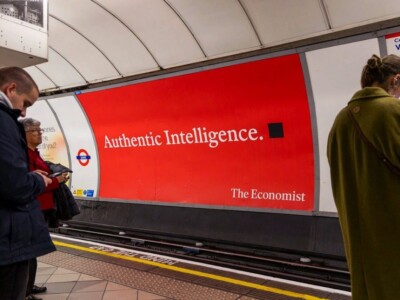
There’s a lot of spots to put this. It could be a display ad, it could be an ad in a newspaper. It could be a postcard, like a mailer. Again, it’s this idea of capturing attention and thinking about the environment in which you’re capturing that attention. So The Economist did this, and it was the first one I saw, which is called Authentic Intelligence.
And I was like, “Oh man, this is so timely. I love the thought process of it.” But I want you to take a look at, forget about the words because the words are great, it’s timely, great. But let’s just look at the board from a marketing perspective. One color for the most part. You got to have the second color for the words. But one color, that’s it. Everything around it is multicolor, dark, light, people. Everything else about it is colorful and this is a gravity well of attention.
Fair?
Stephen Semple:
Fair.
Matthew Burns:
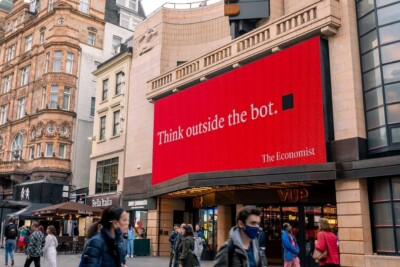
Two words. Okay. Two words. And it was branded with the brand color and then two words, authentic intelligence. And then their iconic black square as the period. So this is the simplest form of communication, two words and you go, “Oh man, that kind of hits me in the gut.” They’ve also got this one. I’m going to let Stephen go into some psychology of this in a minute, but we also have this one where they talked about thinking outside the bot.
Stephen Semple:
That’s my favorite one is thinking outside the bot.
Matthew Burns:
Right? But now think what they did there. They’re taking topical, a phrase that’s already known, flipping it on its ear. So they captured your attention that you feel a little bit comfortable and then you go, “Ooh, wait a second.” And it’s The Economist. We’re talking about writing for… It’s a newspaper, it’s a rag, it’s a way to give information across and they make you think, and that’s what they’re doing in their board. Simply, simply, simply. There’s a couple more that are going to float around.
Stephen Semple:
First of all, there’s a couple of things I want to commend The Economist on doing because what would’ve been a really easy trap for them to fall into is think outside the bot or authentic intelligence, “regular news for business people”. It would’ve been really easy to add that.
Now you think about it, there’s going to be two types of people who are going to read that and see the word economist. There’s either going to be the people who know what The Economist is and now this becomes a really great reminder. Gee, maybe I should subscribe to The Economist because I would like to get authentic thinking. I already know about The Economist. It’s the worldview on these things.
So there’s going to be people who have that. So therefore adding that stuff doesn’t add anything and in fact detracts because it takes away the simplicity. Okay, great. I could hear the words of somebody going, but not everybody knows who The Economist is.
Matthew Burns:
Correct.
 Stephen Semple:
Maybe that creates curiosity and maybe that makes you type in the words The Economist. What the hell is this thinking outside the bot? What is this? The Economist, right? So I actually really commend because I’m going to tell you, I believe that debate happened in the boardroom around these acts.
Matthew Burns:
Oh, this wasn’t easy to make so simple. The decision to allow it to happen was not easy.
Stephen Semple:
So I really commend them for leaving out all the description of it and just going with it. It’s brilliant and it works well for those sets of reasons. So good for them. That was a brave decision.
 Matthew Burns:
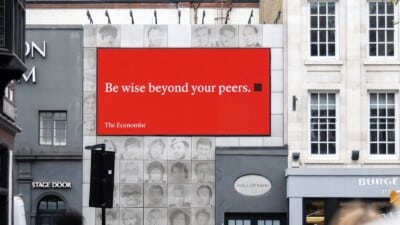
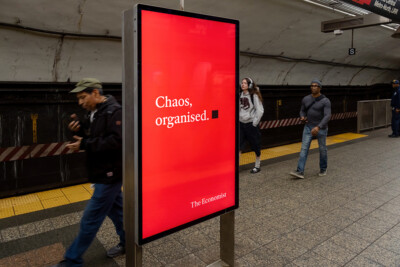
Yeah. And again, when you go back to… Okay, so I remember the other one. So we had think outside the bots, you think about it brings up a phrase we already know, they flip it on its ear. They also have be wise beyond your peers instead of wise beyond your years. And again, that’s a really interesting statement. That’s a really big curiosity statement. What wisdom am I going to get if I go to The Economist as well as chaos organized?
Now chaos organized is my least favorite one, but it does allow me to ask the question, what chaos?
Stephen Semple:
I actually think that is a good one because how are we all feeling right now?
Matthew Burns:
Oh dude.
 Stephen Semple:
Halfway through the administration, and you know people are feeling that when even when I watch CNBC, which is all about stock market and whatnot, even the portfolio managers and the analysts are going, we’re getting tired of every day there’s a new policy.
Matthew Burns:
Correct.
Stephen Semple:
So I actually think the thinking beyond the chaos is kind of not bad because it fits the emotional feeling that we all have right now. The one piece of pushback that we’re also hearing on AI is AI is average and AI is this. So yes, that whole idea of thinking outside of it is fantastic. I think it’s a very, very effective campaign. I would love to see them extend it to social media.
Matthew Burns:
Oh, absolutely. And here’s the thing, and I didn’t go looking for that. I wanted to look at the board. So we can definitely take a look and maybe we can find some things and throw some links in the comments. But I wanted to talk specifically about this because here’s the thing. So we just finished working with or working on a backdrop for trade show booth for a client, right?
Stephen Semple:
Yes.
Matthew Burns:
And again, what we did is we looked at what the environment is of a trade show booth, right? Noise on one side, noise on the other, and that’s never going to stop. It’s always going to be a lot of color, a lot of giveaways, a lot of… You said it’s a two-hour advertisement, right?
Stephen Semple:
Yeah. When a person goes to a trade show, they spend two hours of walking through advertising, relentless advertising for two hours.
Matthew Burns:
Right. And so what do you need to do is you need to break through that noise. So we created this, and this is for a company called A&A Roof, and you can see the little logo there. A&A Roof is a roofing company over on the West Coast or very close to the West Coast in Washington State. They have a curiosity driven statement. What’s that all about? Because it’s part of their campaign, they’re on the radio.
But now when people walk by, again, this is twofold, right? If they know the brand, if they’ve heard the radio ads, but they’re going to start that lines, the second line in a sing-out, in a jingle for them. So if you already know them, now the jingles recall happens. They’re like, “Did you guys play radio?”
Stephen Semple:
Yeah. Play the ad right now. Just inject the ad and I think that will help.
Noe:
Awesome. And amazing.Skylar:
Thank you, Noe.Noe:
Oh, yes, you are, but I meant for A&A, Skyler.Skylar:
So worried about the name.Noe:
A&A Roof doesn’t quite say…Skylar:
We install the best roof in the Tri-Cities with the best team using the best materials.Noe:
Exactly.Skylar:
Noe, it’s not about the name. It’s about how we do the job.Noe:
You’re right, but…Skylar:
Of course I’m right. I’m always right.Noe:
But…Boisterous Singing:
A and A roof, what’s that all about? Did they run out of names? Or just chicken out when every roofer sounds the very same? How’s anybody meant to remember the name?Noe:
Awesome. And amazing. It’s right there.Skylar:
I think you’re awesome and amazing. You are my A&A.Noe:
For a roof-Skylar:
You’ll never have to worry about-Noe:
Come see us at A-Skylar:
And A roof.comBoisterous Singing:
How’s anybody meant to remember the name?
Matthew Burns:
Right? So now you get the audio cue that comes up when you hear that phrase and it’s a question. The other thing is it’s what’s that all about? And then A&A roof. What’s that all about? And then A&A roof. And that’s not normal. That’s a curiosity play all day long.
Stephen Semple:
Yes.
Matthew Burns:
Right?
Stephen Semple:
And curiosity, if you want to start a conversation with people, curiosity is the most powerful emotion.
Matthew Burns:
We’ve also done this with things like work trucks for clients. So we work with air conditioning and heating and anybody who’s driving around in a big van, so the mobile billboard. And when you think about the mobile billboard space, it went from the white truck syndrome where there was no labels that’s ever maybe a tiny phone number on the door, right? So all of a sudden everybody’s got these super colorful everything all over the place and we go, okay, wait a second.
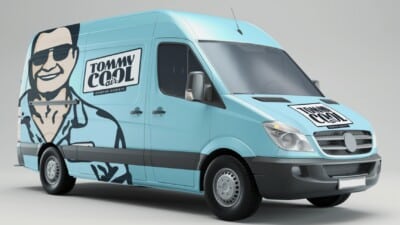 So in that noise, how do we want our clients to look? How should they represent? And then I did this for Tommy Cool. One color. Remember with The Economist, one color. I want you guys to understand this is something that can be used over and over over different mediums and then a very simple message, tommycool.com. And then their standard be cool on the back because that’s his thing is everybody be cool. I want to know from you guys, we’ve not really leaned into asking you guys, how would you use this? How could you see in your brand and for your clients, how could you use this technique of making sure that perspective is thought of? Where are you seeing it? What’s the use case?
And for The Economist, they had to think about the fact that it’s going to be all over the place. So where’s the noise that they’re going to be… Simplify it, make it really simple.
And then messaging. Guys, messaging, it’s so important. Think through this stuff. Don’t just start selling… Advertising is not sales. Sales is done in the sales office or in the home. If you’re a service provider, it’s not done in the advertising. What’s the curiosity that makes them ask more questions? How do you draw them into your brand?
And again, Steve, I want your final words, but guys, ask questions, let us know what you think.
Stephen Semple:
Really good. So I’m just going to leave one last thought and it’s sort of this bit of a summary of what you just said. Way too often, people spend too much time thinking about the media and then again, the messaging comes second. We deal with this all the time where somebody’s like, “Should I do this? Should I do that?” And it’s like, “Well, what’s the message first?” The message is right. The media always works. And how can I prove people do it? They’ll buy advertising somewhere and then go, “Okay, so what should we say?” They will decide to go to a trade show and they go, “Okay, what should we do for the trade show?”
Matthew Burns:
Exactly.
Stephen Semple:
Rather than, “Have we got a good idea for a trade show? We got a good idea for a trade show. Let’s now find a trade show.” That’s the order you should be doing things.
Matthew Burns:
Correct. Yeah. No, perfectly said. Economist, again, we’re giving you guys full props. This is fantastic marketing. It’s fantastic advertising.
Stephen Semple:
Please don’t stop doing it. Really, really, really well done.
Matthew Burns:
Guys, drop your comments, likes, all that kind of stuff, and we will see you on the next Sticky Sales Stories.

- The laziest looking ads are secretly GENIUS - November 10, 2026
- The genius ad that BLEW UP a whiskey company - November 3, 2026
- Why this boring billboard is a SLAM DUNK. - October 20, 2026