
Watch above or read below.
Matthew Burns:
Welcome back to Sticky Sales Stories with Stephen and I. We are going to talk a little bit today about an older campaign that was done by Volkswagen. It is probably one of my favorite ones. I think you covered this. So I’m cheating a little bit today, Stephen, because I think you covered this on the Empire Builders Podcast on the whole story of Volkswagen and how they brought the bug to America, but it’s the advertising and what made it really sticky that I want to talk about here. So we’re talking about the Think Small campaign. Talk to me about what they did. Give us a brief history of what they did, and then I’m going to start throwing up some ads.
Stephen Semple:
So they’re wanting to penetrate the US market with the Beetle. Now, one of the things we’ve got to remember, because context really matters here, is that at the time, if you took a look at all of the advertising run by the North American car manufacturers, by Ford, by Chrysler, by all of them, because remember Chrysler was its own thing. General Motors, all of them made the cars actually look artificially large.
It was all about the car being big, big, big car, big luxurious car. Imagine this boat parked in your driveway. And if we think back to the 50s and the 60s, the cars did get large. Especially when we got later into the 70s, they were these big boats. They were these enormous cars. And all of the advertising was very colorful, was a lot of illustration-heavy, and all these things to make the car look really large.
So the belief was that to sell a car successfully, you need to make it look big and luxurious. That was the belief in the automotive industry. Then along came Volkswagen wanting to sell this little tiny car.
 Matthew Burns:
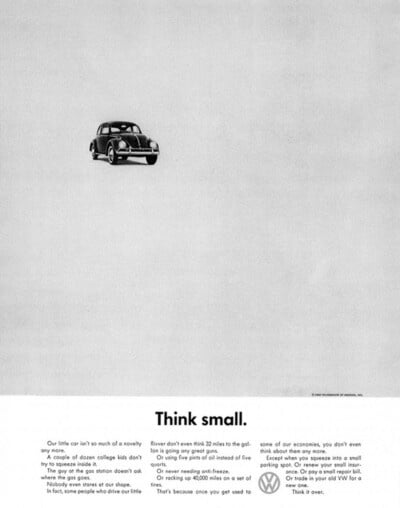
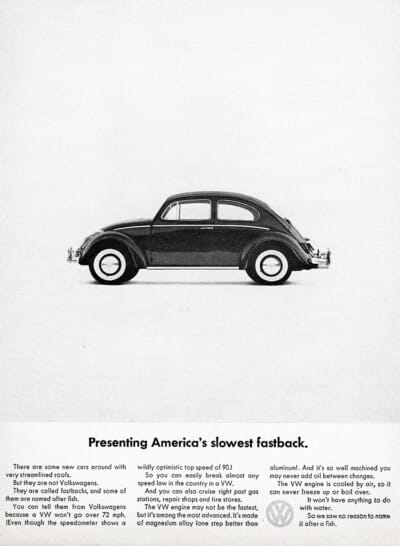
This little teeny weeny little bug. What was really interesting was, I mean, you think about, we talk a lot about frame line magnetism and making things fall off the page and focusing on a very specific thing. And all of that’s true. I don’t want to take away from any of that. I mean, it’s really good advice, and we can go into a whole thing on what glamour is. But Volkswagen said, “Nah, we’re not doing that. We’re going to go completely opposite. We’re actually going to show you how you can get away with a compact vehicle.” And they did this. I’m going to put it up on screen. They did think small. Holy crap. That is a lot of wasted real estate when you think about it.
Stephen Semple:
Right. Well, and that’s the other thing about it is that it actually made the car feel small with all of that wasted white. And you think about it in a magazine, people would be like, “But look, you’re wasting all this white space.” But they were leaning into the thing they were. They’re a small car.
Matthew Burns:
Exactly.
Stephen Semple:
Own it. Don’t try to make it look bigger. It’s small.
 Matthew Burns:
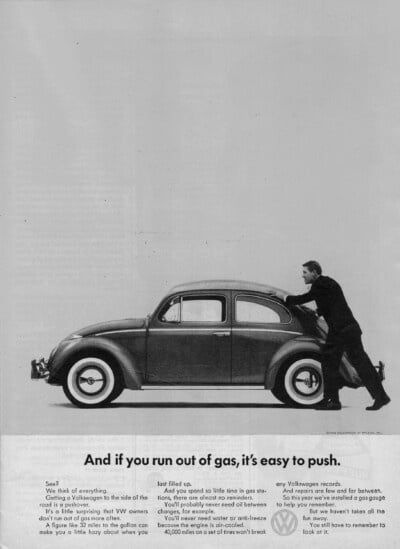
There are a lot of things that go along hand in hand with that, which they don’t have to spell out as much. It sips gas. It’s a smaller car. It’s lighter. It doesn’t need as much gas to do the job. I mean, one of the ones that will float by, you’ll see, is the idea that it’s easy to push if you ever run out of gas. And I love how they did it in the copy because they talked about how, because you don’t see as many gas stations driving this vehicle, you might forget to put it in. And if you do, this one’s easy to push to the side of the road. And I thought, wait a second, that’s really an interesting way to say it’s really good on gas by actually highlighting the opposite. So again, it’s these really good, really well put together, great copy, amazing visuals that tie to the thing that they’re selling. They’re selling a small compact vehicle.
Stephen Semple:
Well, and there are two things to consider also in this is one, and we often talk about great brands are not created; they’re revealed. The car was small, reveal that it’s small, make it feel small because that’s true. But the other part is that where the brilliance in all this is, is the market that was being ignored was people who actually didn’t want a big car because everything was big car, big car, big car, big car, big car. They pivoted the opposite direction. And look, created a car that for a really long period of time held sales records.
Matthew Burns:
Oh yeah. I mean, it was the only one available that did the job that it was meant to do.
Stephen Semple:
Right.
Matthew Burns:
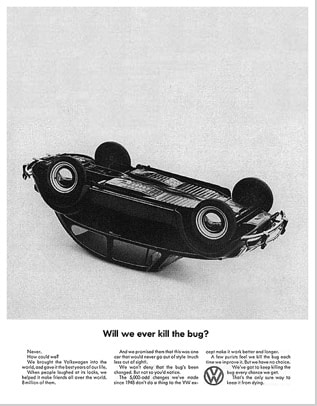
Absolutely. Everything kept getting bigger and bigger in the United States. The roads are big. There’s lots of wide… And coming from Europe, coming from a spot where road space is tight, and parking space is tight, we don’t have long driveways in Europe. They don’t have three- or four-lane roads. A lot of times you can barely get by in the one-lane road on the cobblestone streets. So they made a vehicle that did its job. And so the extra highlights of all of that, they played up. I mean, I’m not going to go through all the different things, but it’s a massive campaign where they put a car up on its roof, and it said, “Will we ever kill the bug? Are we ever going to discontinue?” So they just talk about the longevity of the thing. It became so iconic that the Herbie the Love Bug movie came out
Did it work? Oh, it worked and it worked in spades. I mean, I don’t have the sales figures, but it was unreal how well it worked. And there are collectors now of the Bugs.
Stephen Semple:
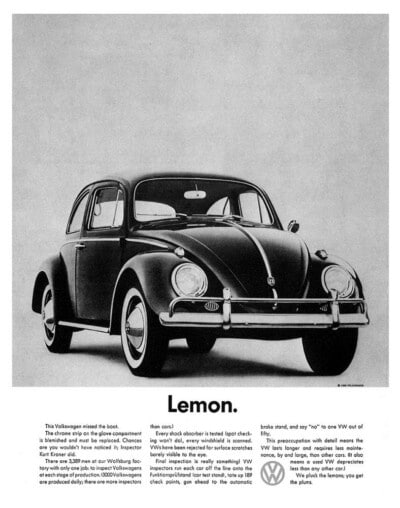
I said, it held sales records for a long period of time. And then later in the campaign, they remained even clever later in the campaign when they talked about the affordable price of the car. I remember there was one which showed a picture of a competitor’s car and you could have this or, and it showed a picture of a Beetle along with all sorts of stuff like a set of golf clubs. But instead of putting it to a price, it was like you can have this or you can have this and all these other things.
Matthew Burns:
That’s what I’m saying. They did such a good job of picking a very specific point and wrapping all of their copy, all of the advertising around this very specific point, which unfortunately most advertisers don’t do. They go, “We do all of this. We will be able to serve everything you need.” And they’re just saying, “No, we’re just small. We just made it really small.”
Stephen Semple:
But you made a good point too, is that they recognize the intelligence of the consumer. When you say the car is small, what are a bunch of things that we already know? Better on gas, right? There’s all sorts of things. Better on gas, more economical, easier to park. There’s all sorts of things we already know when the car is small.
 Matthew Burns:
There was one ad, and I’ll try and find them guys. They’ll be floating around here, but there’s also one ad where it talked about the tires not wearing as fast because again, it’s not as heavy. It doesn’t have as much friction. And again, just put them out slowly but surely, so they continued the story, and they ran that campaign for a long time.
Stephen Semple:
One idea at a time. Yeah.
Matthew Burns:
Yeah. Now it reminds me a lot about when I first hired the Wizard of Ads, you specifically, Steven, and you dumbed down my graphic design for the trade show booth. We’ve done that episode, and it became much more specifically centered on that thing, and that it allowed the conversation actually to go in the way that the consumer wanted; the consumer got to put their mind to it. And that’s what I love about this: it’s so simple, yet it allows for so much to come out of it, and it became. I mean, let’s face it, it became very sticky. So I’ve been wanting to talk about this one for a while. I know you had all the details in the back end on it. I just really love the ad. But anyway, okay, awesome. Thank you so much, guys.
I want to reach back into the archives. I’m going to do a couple in a row, I think, of archival-type advertising so that you can see how far we’ve come and how good some really good campaigns from the past were. So stay tuned, like, subscribe, all that stuff. Steve, thank you, my man.

- Jameson Whiskey – How They Won The World - October 11, 2026
- Why Volkswagen bet everything on the Beetle - September 28, 2026
- The Problem With Almost Every Car Commercial - September 13, 2026