
Watch above or read below.
Matthew Burns:
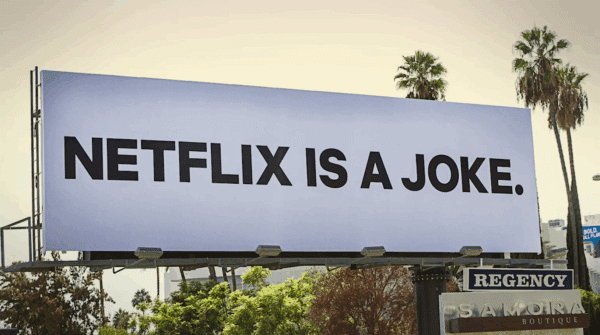
Stephen and I, we had a little bit of a disagreement, which is totally fine. We typically do. We don’t see things exactly the same. Stephen wants me to show you something, and then he’s going to go off on it. So, something that he really likes is this billboard campaign by Netflix. Okay. So these boards are going to keep playing.

Stephen Semple:
Here’s what I love about it. So there’s a whole bunch of things. Statement: “Netflix is a joke” on its own is a negative statement about Netflix.
Matthew Burns:
Correct.
Stephen Semple:
So Netflix had the guts to throw up a-
Matthew Burns:
No URLs. No, nothing else.
Stephen Semple:
No design. Netflix is a joke. And look, a lot of people go, “Yeah, that streamer is a joker.” But the whole thing, the mystery, is a super-powerful emotion. And when you present a mystery to people, the brain processes it. And there’s a technique in advertising called teaser campaigns, and they’re based upon mystery. Now, if I were going to give one complaint on those ones, they didn’t resolve the mystery well. But mystery is super, super powerful.
And when you use it with billboards, man, you can create a whole campaign where you take people down this mysterious path. There was a campaign I mimicked. So it was run in Halifax when I was in university, and it was for James Ready Beer. And it was the most successful beer launch in Canadian history at the time. And the campaign started with “Ready.” That was it. Ready. And then the question, are you ready?
And then it was like, are you ready for James? And then the beer came out. Are you ready for James Ready? And they would show the beer. But everybody was like, what? And so we did one for an indoor play space. Unfortunately, they didn’t survive the pandemic, but it was Jack’s Urban Jungle.
Matthew Burns:
Yeah. Indoor place.
Stephen Semple:
Right. And the first one was like Jack.
Matthew Burns:
Jack.
Stephen Semple:
Who’s Jack? And I was like, not who? Where? We had this whole thing. And in the town we ran it in, the owner, because this was all pre-launch, would talk about how he’d be biting his tongue because every party he went to that Christmas, everyone was talking about and trying to guess what the hell it was.
Matthew Burns:
Correct.
Stephen Semple:
And he was sitting there … Everyone in town was talking about these billboards.
Matthew Burns:
It’s kind of what I liked about the Netflix one, because really, what question marks go through people’s minds is, is this a competitor calling out Netflix as being a joke? Is this some rich bastard who’s like got more money than brains, and he’s just throwing shit on boards because that’s happened before?
Stephen Semple:
Yes.
Matthew Burns:
You don’t really, truly know what this message is, except that somebody somewhere, even if it’s Netflix, is throwing shade at Netflix.
Stephen Semple:
So brilliant a campaign.
Matthew Burns:
Yes.
Stephen Semple:
And then, and I’m going to guess because of this, wow, there were so many people who didn’t understand what it was.
Matthew Burns:
Yeah.
Stephen Semple:
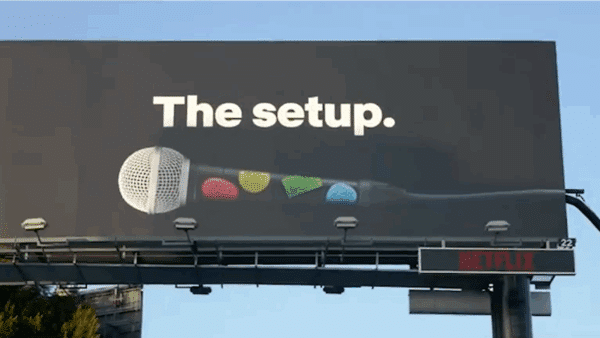
Here’s what they ran next, which was still a good campaign because when it comes to billboards, it was better than fricking average. Usually, visuals don’t add anything to the story, and there are too many words. So yeah, so why don’t you show these next ones? But here’s the problem. There’s no mystery.

Matthew Burns:
No.
Stephen Semple:
You’ve now… Oh, it’s a microphone. Oh, and then there’s a punchline. Oh, this is about a comedy act. And they would’ve even been better if they had run one billboard and then the other later and created even a tiniest little bit of mystery. But they immediately went to… Look, somebody on the committee somewhere, or some marketing idiot who has no idea what they’re doing, because they’re plentiful out there, went, “You know what? When we were reviewing the social media and the other ones, there was a whole pile of people who couldn’t figure it out. So you know what we need to do is connect the dots so everybody understands it. ”
And suddenly no mystery, no conversation, no debate. But I will say this, they’re good billboards.
Matthew Burns:
Right.
Stephen Semple:
Just not as good as the other ones.
Matthew Burns:
Right. And so what I was going to say, so it’s not a good campaign. I think that’s where you’re having the hardest time. It’s not a good campaign. The teaser campaign would’ve been brilliant if they continued to do things incrementally as they got closer and closer to where they really were going to go on sale, and then do their big reveal.
And I think the failure, and again, you and I will see this a little differently, but I think the failure is that we do sticky sales stories. Stories are the big underlining asterisks surrounding both… Stories make it sticky. And this is the problem. What they did was they started, and they ended, and there was no middle.
Stephen Semple:
And this is the other part when you’re using mystery, what they don’t realize is you can run billboards in a series, and people will follow along. We did a billboard one time in California. It was a text conversation, and every two weeks, we would add the next line with the dot dot so you knew more was coming.
And we literally had social media posts where people figured out it changed every two weeks, and somebody would literally drive a little bit out of its way because they wanted to see the next installment of the conversation.
Matthew Burns:
Yep.
Stephen Semple:
Think about this. The person is driving out of their way to read our advertisement because they want to hear what the next installment of the conversation is.
Matthew Burns:
Correct.
Stephen Semple:
And there was no branding on it until the very end, where the person said, “Here’s who you got to call.”
Matthew Burns:
But I do want to talk about the second part of the campaign that we showed, so the one where the microphone’s connected to the box, which says Netflix is a joke, and then it reveals the whole thing. If they ran that only, I don’t think they should have, but if they ran that only, what I loved about that was they took two billboards that can both be seen, connected the two billboards physically, which means you had to look.
And here’s the thing, it was powerful messaging because people stopped to video it. The video that we saw was just one of those online. It’s stopping people; they’re paying attention. They did a good job. It would be brilliant if that’s what they put up and they kind of ran that, or maybe a couple of versions of that, that would be fine. But what they didn’t do was they started somewhere else and then finished here, and they didn’t complete, they didn’t connect the story or bring them through, bring them through, and really draw that out.
Stephen Semple:
Right. Because what they’re looking at going is, I have two billboards, and what they didn’t think about is if you create enough mystery, people will come back. It’s called cliffhangers. Watch sitcoms from the ’80s, and you’ll learn something about cliffhangers. But if you’re really skilled and you create good mystery and intrigue, you don’t have to resolve because they’re like, “Well, we would need three billboards to resolve the story.” Don’t resolve it. Let some time go by. You can do the second installment, let some time go by, and then you can finish the story. Advertisers fear mystery.
Matthew Burns:
Correct.
Stephen Semple:
We did a radio campaign for Travis Crawford, Heating and Air Conditioning, and it ran for four months on the radio, where we did not tell anybody what he did. And you know what ended up becoming the most popular way for people to find him on his website? Who is Travis Crawford?
Matthew Burns:
I think that’s crazy good. But this episode, and everybody, you’re watching epiphanies happen, but we’re on a call this afternoon, you and I, to talk about one of our shared clients’ billboard campaigns.
Stephen Semple:
We are, ironically.
Matthew Burns:
And it is a new thing. We are literally talking about how we are going to show their new offer to the world, we’re going to be talking about how we launch this out on their billboard campaign. We’ve done it on the radio. Yes. I’m just saying there might be a way for us to be a little bit sneaky here. And I don’t know how to do it because they’ve got billboards all over their area.
But anyway, guys, listen, we would love to find things — if you notice, what we’re trying to do is show what’s really, really brilliant. But then even really, really brilliant marketing sometimes has to listen to a boardroom, and the boardroom, unfortunately, will try to be safe, and it takes some of the extra power out.
We don’t believe in being safe. We believe in really putting yourself out there on the tippy top edge of what is awesome, so you can be brilliant, and that’s what we would love the world to understand about great marketing and advertising.
So Steve, that’s awesome. I really appreciate you talking about Netflix is a joke.
Stephen Semple:
You know what? It is a joke.
Matthew Burns:
It is a joke. Guys, thanks for joining us, like, subscribe, all that stuff. Give us some comments. What else? What did we miss? What would you guys like us to talk about? And we’ll see you guys on the next episode.

- Jameson Whiskey – How They Won The World - October 11, 2026
- Why Volkswagen bet everything on the Beetle - September 28, 2026
- The Problem With Almost Every Car Commercial - September 13, 2026