
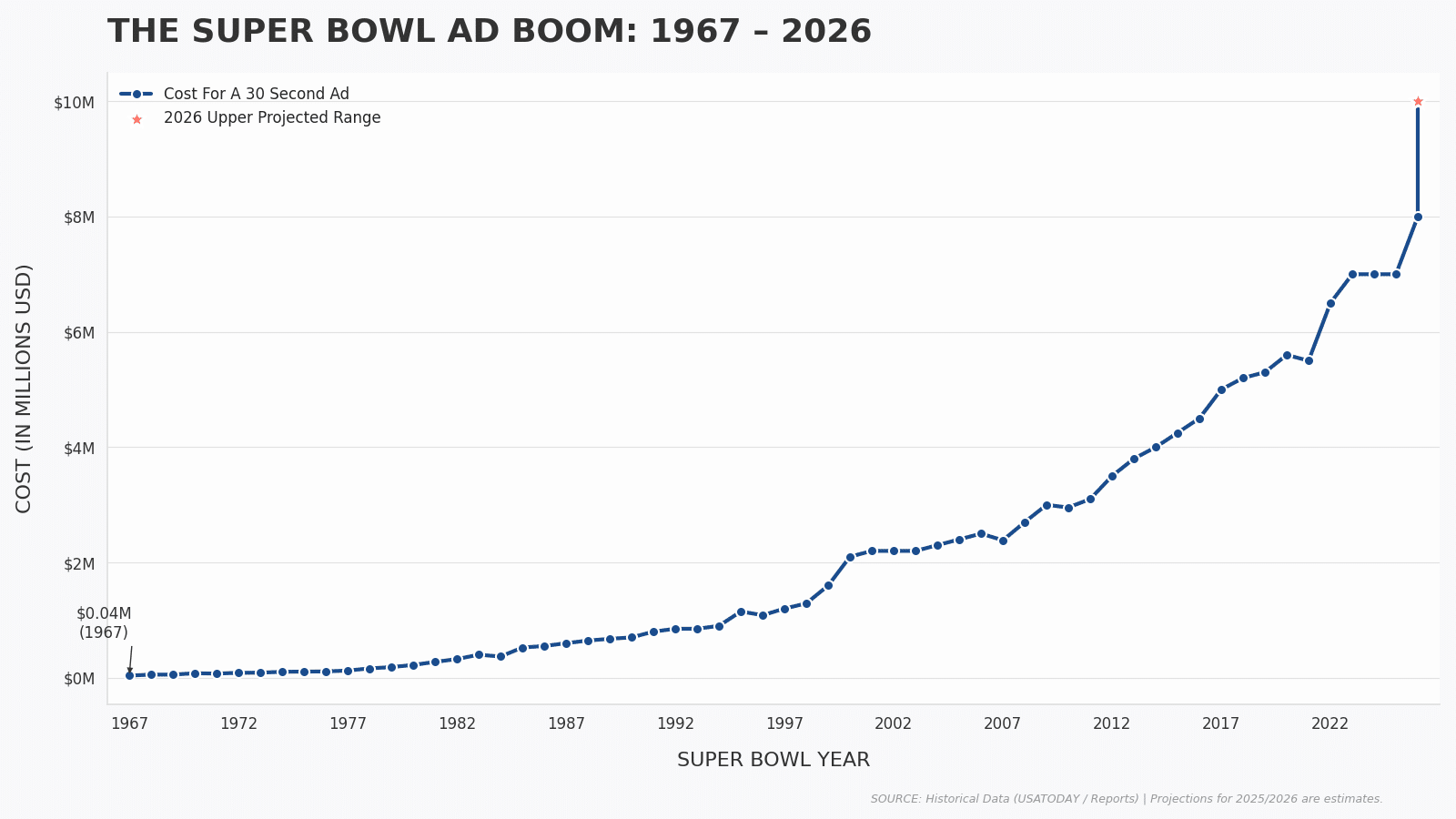
When Vince Lombardi’s Green Bay Packers defeated the Kansas City Chiefs, 35-10, in Super Bowl I in 1967, a :30 second television advertisement cost $37,000, according to AdMeter from USA Today. A case of Schlitz, the number one beer in the country at the time, cost $1.87. Bugles, the popular corn snacks, were released in 1967. Jim Delligatti invented the Big Mac in 1967, and it debuted in the Keystone State. Super Bowl watch-parties probably weren’t a thing just yet. And neither was the “let’s watch the Super Bowl ads” craze.
According to Entrepreneur Magazine, now, more than 115 million Super Bowl viewers, approximately 45% of the total audience, tune in JUST for the advertisements.
If you’re curious about what an ad costs every year, and how they’ve increased, you can check that out here.
The interwebs will tell you that there was not one standout television ad during that first Super Bowl, and they’ll also inform you that the first memorable and widely recognized Super Bowl commercial was the Mean Joe Greene Coca-Cola ad from 1979 (my personal all-time favorite).
According to History.com, Apple’s “1984” Super Bowl ad was the first blockbuster Super Bowl ad that created the insanity that has enveloped Super Bowl advertising for the past 42 years.
By the way, the cost for a :30 ad for this year’s Super Bowl was just a bit more expensive than it was in 1967. Here’s the cost breakdown for a Super Bowl ad in 2026.
Similar to skipping Bad Bunny’s show this year, I also was not watching the Super Bowl halftime performance on February 1, 2004, when Justin Timberlake tore away a portion of Janet Jackson’s outfit in, perhaps, the first Super Bowl wardrobe malfunction. Never saw it live. Had to Google it. Did Google exist in 2004?
If you’re curious about every Super Bowl halftime entertainer since 1967, you can go here.
Some reports say that 10 million people turned off the Bad Bunny halftime show. Other reports indicate somewhere between 7 and 8 million.
The first Super Bowl I can remember watching was the Cowboys’ victory over the Dolphins in 1972. I’m sure I watched before then, but that’s the first one I recall vividly. It was just my Mom, Dad, and me watching that game, and my younger sister might’ve popped her head in once in a while just to see that the three of us were alive. Or to inquire about dinner.
For nearly 60 years, if my math is correct, humans have strategically utilized the halftime of all sporting contests, not just football, to go to the latrine and to get a cold beer, to refresh their nachos, and to discuss what transpired between the two teams they’re watching in the first half of action.
I was NOT the only person who did not watch Bad Bunny. And it has nothing to do with politics. Certain agencies will tell you that the viewership for Bad Bunny was in the 10s of millions. I call bullshit. You know why? It’s impossible to measure. Because NOBODY turns off their television during halftime of anything, especially the Super Bowl. They leave the television on. While they’re lining up at the men’s room. While they’re getting another cold one. While they’re loading up another pulled pork sandwich. The people claiming Bad Bunny was a huge hit are the same ‘experts’ who claimed no one saw Janet Jackson’s breast.
If you’ve ever attended a LIVE sporting event, a concert, or a Broadway play, you know I’m right. When there’s an intermission in the action, you’re relieving your bladder, and you’re satisfying your dietary needs and your fluid requirements. That’s why all entertainment venues have more people working during halftime and intermissions than at any other time of the day.
What’s my point? Advertisers and marketing folks need to know their audience.
The research engines estimate that roughly 77% of the NFL fanbase is Caucasian, 15% is African American, and 8% is Hispanic. Further, 47% of male viewers are age 55 and older. The important question is, was Bad Bunny a good BUSINESS decision for the halftime show? Difficult to say.
According to the American Marketing Association, knowing your target audience and connecting with your target audience can improve sales 20%. See the full report here.
Based on the demographics that I laid out, did the NFL connect with its primary audience with the Bad Bunny shenanigans? Let’s look at the bigger picture. Of the 32 NFL teams, 26 teams lost attendance this year. This reflects a year-over-year trend. If your business has been losing live audience steadily for a decade, you might want to self-reflect.
A business owner’s decision-making about an advertising spend or about developing a marketing plan shouldn’t be influenced by what is done at NFL headquarters. Or any monolith. You should be thinking strategically, for example… should I buy my advertisement in the first half of the game because it might be a blowout in the second half and no one will be watching?
I can also make an argument that the NFL itself, the league, is missing a marketing opportunity. Go back to the demographics of the NFL audience. Why was Bad Bunny just a halftime show? Why isn’t there a thoughtful strategy behind expanding the NFL audience? If you follow the NFL at all, then you know that part of the answer is that there is no leadership at NFL HQ. If there was, Bad Bunny would’ve been part of a comprehensive strategy and not just a goofy tactic.
So next time you’re thinking of dumping a bunch of money on the halftime show or into ads during the big game, just know that most of us will be standing 10 deep in the bathroom line, and then we’ll be getting a fresh, cold Iron City to go along with a Primanti Brothers Pitts-Burger and cheese with a side of funnel cake fries.
If you’re curious about how to better invest your resources to attract the kind of customers that you want lining up for your business, or you want to expand your audience, give me a shout. I’m happy to walk you through it.

Dave is the author of multiple books including Final Four Leadership.
- Radio is NOT Nostalgic, It’s Just Good Business - August 7, 2026
- Kindness Is Free - June 23, 2026
- I Love Southwest Airlines - May 20, 2026